CloudBeaver
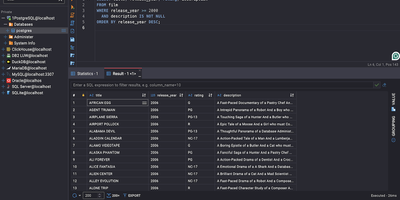
CloudBeaver puts a full-featured database management environment in your browser, connecting to PostgreSQL, MySQL, SQL Server, Oracle, ClickHouse, and over 100 additional engines through one unified interface that requires no desktop client installation. The Java server exposes a TypeScript/React frontend through a GraphQL API where teams can browse schemas, edit data, visualize relationships, and execute queries across all connected databases in a single workspace. The SQL Editor provides syntax highlighting, auto-completion with fuzzy search, AI-assisted SQL generation from natural language prompts, script management with save/download/upload capabilities, execution plan visualization, and multi-tab result display. The Data Editor enables direct cell editing, filtering, sorting, and bulk data modification with support for spatial GIS data rendering. Database administrators access a Navigator panel for browsing schemas, tables, views, foreign tables, triggers, dependencies, and stored procedures across all connected databases. ER Diagrams visualize table relationships and schema structure, while the Visual Query Builder constructs queries without hand-writing SQL. Multi-user administration provides role-based access control, connection sharing with configurable permissions, and session management. SSH tunneling secures remote database connections, and data can be exported or imported in multiple formats. Query History tracks all executed statements with timestamps and execution statistics. Running on a dedicated VPS on RepoCloud with guaranteed CPU, RAM, and SSD, full root SSH access, and a browser serial console. Apache 2.0 licensed.
Kubewall
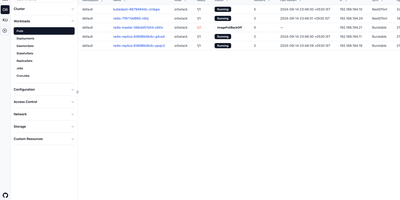
One binary is all that stands between you and every Kubernetes cluster you own: Kubewall opens a realtime web dashboard over all of them, with no agents to install and nothing phoning home. Switch between clusters from the sidebar and browse workloads, networking, storage, configuration, and access control in tables that update live as pods start, fail, and reschedule. Open any resource to inspect its overview, edit its manifest in the built-in YAML editor with validation, watch its events, or stream logs aggregated across pods and containers with search and tail controls. A command palette jumps straight to any resource type, while faceted filters and global search cut through thousands of objects by name, namespace, label, or image. Scale deployments, restart pods, trigger rollout restarts, and apply manifests with a click, or forward a cluster service to your local machine without memorising kubectl incantations. An integrated AI assistant, connected to OpenAI, Claude, Gemini, DeepSeek, OpenRouter, Ollama, or a local model, helps troubleshoot failures and review configurations right beside the resource it concerns. Running on a dedicated VPS on RepoCloud with guaranteed CPU, RAM, and SSD, full root SSH access, and a browser serial console. Apache-2.0 licensed.
Concourse
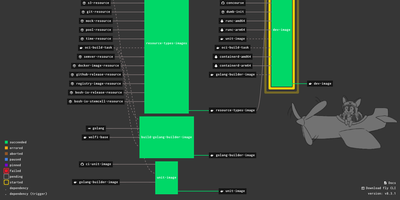
When a commit lands, a timer fires, or a pull request opens, Concourse runs the matching jobs in fresh containers and draws the entire CI/CD pipeline as a live graph you can read at a glance. Pipelines are plain YAML files that tie resources such as git repositories, registries, and buckets to jobs made of get, put, and task steps, so the same file behaves the same on every installation. Resources are checked continuously for new versions, webhooks can request an immediate check, and a version can be pinned when something needs to stay put. The dashboard lists every pipeline by team with status colors, a filter box, favorites, and a high-density view, while build pages stream colored logs and let you rerun a build with the exact same inputs. The fly command line sets pipelines, runs one-off tasks against local files from your laptop, and opens a shell inside the container of a failed step. A set_pipeline step lets pipelines configure other pipelines, and instance vars create a family of related pipelines, such as one per pull request. Teams keep projects separate and can be tied to a GitHub organization, credentials arrive at run time from Vault, CredHub, AWS, or Kubernetes, and policy rules can block disallowed images. Running on a dedicated VPS on RepoCloud with guaranteed CPU, RAM, and SSD, full root SSH access, and a browser serial console. Apache-2.0 licensed.
UseAgent
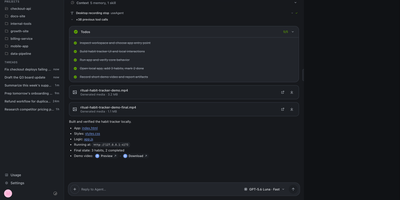
Hand a task to an AI teammate the way you would hand it to a person: describe the work, then follow along and step in when it matters. UseAgent runs Claude Code, Codex, OpenCode, and Pi inside isolated Linux workspaces, each with your repositories, a terminal, a real browser, and a desktop you can open and take over. Start work from the web app, by mentioning an agent in Slack, or through the API, and get pull requests, documents, spreadsheets, presentations, and research back as usable files. Four engines share one thread and one event format, so you can compare how Claude Code and Codex each handled the same bug, then switch engines on the next reply without losing history, files, or memory. Risky operations pause at approval gates, and a decision resumes the run with a one-shot, argument-bound capability instead of blanket trust. Every step, tool call, and approval is stored as an append-only event log in your Postgres, replayable after the fact and durable across restarts mid-task. Teach the workspace your procedures by importing versioned skills from GitHub and pinning playbooks to tasks, while knowledge pages and optional team memory stay beside the work, inspectable and correctable. Recurring tasks run on schedules with full history. Provider keys stay on your server and never enter an agent sandbox. Running on a dedicated VPS on RepoCloud with guaranteed CPU, RAM, and SSD, full root SSH access, and a browser serial console. AGPL-3.0 licensed.
docat
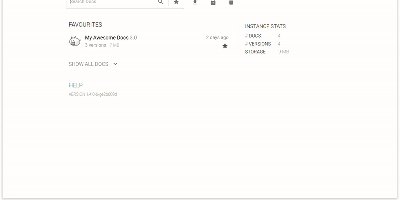
Hosting finished documentation for many projects at once, Docat leaves every uploaded version online for the readers still on version 2. Zip the static HTML that MkDocs, Sphinx, or mdBook produced. Send it to a project and version with curl or the docatl command line client. Tag the newest build as latest, and links get a stable address. Readers land on a home page that opens on starred favourites. A search box narrows the list, and its queries can be shared as links. Instance statistics report documents, versions, and storage. Inside any docs page, a version dropdown with a latest label moves between releases. Uploads are open at first. Claim a project and it returns a token that must accompany every later version upload or deletion. The same token hides versions from the dropdown and from search, and each project can carry its own icon. Operators can mount a small config file for custom header and footer HTML, raise the 100 MB default archive limit with an environment variable, and put nginx basic authentication in front of the write endpoints. Swagger UI and ReDoc pages at /api/docs and /api/redoc document the HTTP API for pipeline authors. Running on a dedicated VPS on RepoCloud with guaranteed CPU, RAM, and SSD, full root SSH access, and a browser serial console. MIT licensed.
Motor Admin
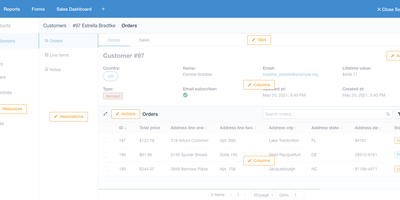
Stop building internal tools and ship your actual product - Motor Admin exists for exactly that. Point this Ruby/Vue application at a PostgreSQL, MySQL, MariaDB, or SQL Server database and it generates a complete CRUD admin panel from your schema in under a minute - search, filters, create, update, delete, all through a polished UI, with every customization done through in-app settings rather than a DSL or boilerplate code. What elevates it beyond CRUD generators is the business-intelligence half: write SQL queries (with variables) and render results as tables, numbers, line/bar/ pie charts, funnels, or markdown; organize reports into shared dashboards; and attach queries and dashboards directly to resource pages as tabs, so an order record shows its revenue history in place. Operations beyond CRUD are covered by custom actions and a WYSIWYG forms builder that posts to your existing REST or GraphQL APIs - send a refund, trigger an email, whatever your backend exposes. Email alerts deliver scheduled reports, Slack sends personalized report alerts, and intelligence search spans all resources. Governance is included: role-based permissions with row- and column-level control (CanCanCan), an audit log of admin activity, multiple database connections, and configuration sync between staging and production. Mobile-optimized, AGPL-licensed, also available as a Rails engine.
Amplication
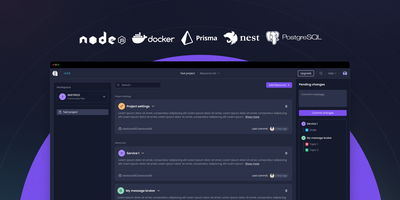
Amplication turns entity definitions into production-ready backend services, generating NestJS with Prisma and Apollo GraphQL for Node.js or ASP.NET Core for .NET, eliminating months of boilerplate. The plugin-driven Data Service Generator hooks into code generation lifecycle events, enabling teams to inject CI/CD manifests, proprietary authentication schemes, testing configurations, and cloud-specific deployment targets for AWS, Azure, and GCP without forking the core generator. Blueprint templates encode organizational architecture standards, security policies, and coding conventions into reusable foundations that keep every generated service consistent across the engineering organization. Jovu AI translates natural language requests into entities, relationships, fields, modules, DTOs, and custom API actions, automatically aligning each resource with predefined standards. Generated services include full CRUD operations with input validation, Swagger/OpenAPI documentation, authentication middleware, database-agnostic ORM via Prisma, optional React Admin interfaces, and Jest test scaffolding. Code output syncs to Git repositories as pull requests, preserving standard review workflows while letting developers edit every generated line and add custom business logic. Supports PostgreSQL, MySQL, and MongoDB as database targets. Over 16,000 GitHub stars with enterprise adoption. Apache 2.0 licensed.
Engraphis
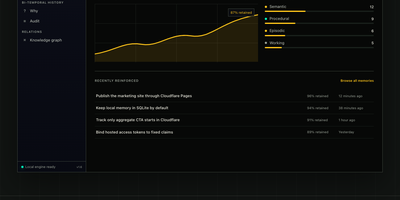
Engraphis is a durable memory layer for coding agents that answers questions like what did we decide about the auth layer three weeks ago, and why, with inspectable project memory that survives across sessions and repositories instead of evaporating when a chat ends. Store a decision once and recall it later in a new session, scoped by workspace, repository, and session so one project's facts never leak into another's context. Recall blends vector, lexical, graph, and code-aware retrieval, then packs the strongest evidence into a hard context budget your agent can actually use. Every returned fact keeps its provenance attached, and the engine cites its support or abstains when the evidence is too weak to trust. Facts are never silently overwritten: bi-temporal history preserves earlier versions, and a timeline view surfaces superseded knowledge when you need to know what used to be true. Index a repository into a code-symbol graph and ask what calls a function before you change it. Conflicting or quarantined memories wait in a review queue for a human decision. Running on a dedicated VPS on RepoCloud with guaranteed CPU, RAM, and SSD, full root SSH access, and a browser serial console. Apache 2.0 licensed.
Doccano
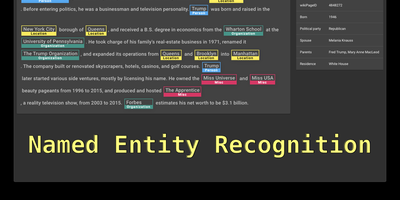
Doccano is a text annotation platforms for building machine learning training datasets. The web-based interface supports text classification for sentiment analysis and document categorization, sequence labeling for named entity recognition with overlapping entity support and relation extraction between labeled spans, and sequence-to-sequence annotation for text summarization and machine translation pairs. Collaborative annotation enables multiple annotators to work on the same project simultaneously with per-user progress tracking, annotation guidelines, example assignment to specific members, and filtering by assignee. Auto-labeling integrates with external machine learning model APIs through configurable request and response mapping templates, allowing pre-annotation that annotators can review and correct. Data import accepts plain text, JSONL, CoNLL, and Excel formats, while export produces JSONL and CoNLL datasets compatible with spaCy, Hugging Face Transformers, PaddleNLP, and other training frameworks through the doccano-transformer library. The Django backend with Django REST Framework exposes a complete RESTful API for programmatic project creation, dataset management, and annotation retrieval via the official doccano-client Python library. Celery handles background tasks including dataset import and export processing with Flower providing task monitoring. One-click deployment supports AWS CloudFormation and Heroku alongside Docker Compose for self-hosted environments. Running on a dedicated VPS on RepoCloud with guaranteed CPU, RAM, and SSD, full root SSH access, and a browser serial console. MIT licensed.
Authorizer
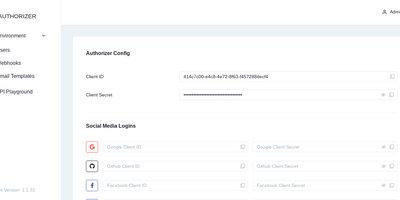
Your users belong in your own database - Authorizer, an open-source authentication and authorization server shipping as a single Go binary, keeps them there. It connects to 13+ backends - PostgreSQL, MySQL, SQLite, SQL Server, MariaDB, MongoDB, Cassandra, ScyllaDB, ArangoDB, DynamoDB, Couchbase, YugabyteDB, PlanetScale, and CockroachDB - so identity data lives beside the application it protects instead of in an auth vendor's cloud. The server is fully OAuth 2.0 and OpenID Connect compliant, including authorization code flow with PKCE, a JWKS endpoint, token revocation, and nine JWT signing algorithms. Login options cover email/password, magic links, TOTP multi-factor, SMS OTP via Twilio, and social providers including Google, GitHub, Apple, Microsoft, and Discord. Authorization goes beyond roles: an embedded OpenFGA engine provides Zanzibar-style relationship-based permission checks in process. APIs are exposed over GraphQL, REST, and gRPC, with SDKs for JavaScript, React, Go, and Python, plus themeable built-in login pages and an admin dashboard. Apache 2.0 licensed.
II-Agent
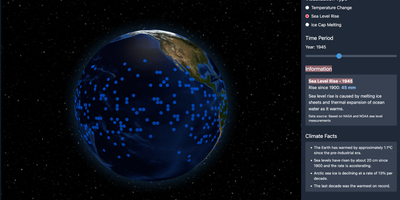
II-Agent is an autonomous AI agent platform that ranked first on the GAIA benchmark by combining multi-step task planning with a full-stack execution environment spanning research, coding, browsing, and content creation. The platform runs a React frontend on port 1420 backed by FastAPI on port 8000, with PostgreSQL for persistence, Redis for task queuing, and MinIO for S3-compatible file storage, all deployable via Docker Compose. Users switch between Anthropic Claude, OpenAI GPT, and Google Gemini mid-conversation using bring-your-own-key authentication. Task domains include deep research with source triangulation, website and mobile app generation from prompts, storybook creation with illustrations, video and image generation via Google Veo and Imagen, presentation building with live collaborative editing, and document manipulation covering PDF extraction, Excel formulas, Word editing, and PowerPoint creation. Built-in connectors integrate Gmail, Slack, GitHub, Notion, Google Calendar, Discord, Dropbox, and Canva for workflow automation. A sandboxed code interpreter runs Python while browser automation with vision capabilities handles web interactions. Custom skills let teams package and reuse workflows. Context management handles up to 120,000 tokens with intelligent window sizing. 3,400+ GitHub stars. Apache-2.0 licensed.
GitBucket
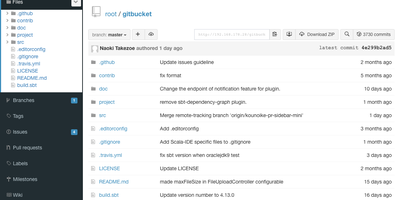
One downloadable WAR file gives your team a complete GitHub-style home for its code, with no per-seat bill and no repositories living on someone else's terms. You create public or private repositories and reach them over HTTP, HTTPS, or SSH, with Git LFS handling large binary assets alongside ordinary commits. The repository viewer includes an online file editor, so quick fixes and documentation tweaks happen in the browser without a local clone. Every repository carries its own issue tracker, pull request workflow, and wiki, keeping discussion, review, and project documentation next to the code they describe. Activity timelines and email notifications keep collaborators aware of new issues, comments, and merges as they happen. Administrators manage users and groups directly, connect account management to LDAP, and protect the instance with fine-grained repository visibility. A plug-in system extends the platform, and official plug-ins add gists, emoji, static Pages hosting, and richer notifications, while community plug-ins widen the menu further. Tools that already speak the GitHub API can point at your GitBucket instead, because its web API deliberately mirrors GitHub's. Upgrades stay simple: stop the process, replace the WAR, and restart with the same data directory. Running on a dedicated VPS on RepoCloud with guaranteed CPU, RAM, and SSD, full root SSH access, and a browser serial console. Apache-2.0 licensed.
LiveCodes
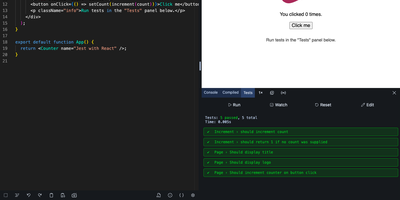
Try an idea in React, Svelte, Python, or SQL without installing anything: LiveCodes is a browser-based playground where code compiles, runs, and previews the moment you type it. Starter templates open ready-made projects for most of the 90+ supported technologies. The desktop editor brings completion, multi-cursor editing, Emmet, and Vim or Emacs bindings, while a lighter touch-friendly editor takes over on phones and tablets. Packages from npm, deno.land/x, jsr, and GitHub import straight into your code, and a console, compiled-code viewer, and test runner show what happens behind the preview. Bring projects in from GitHub gists, GitLab snippets, JS Bin, or zip files, then share them as links or QR codes, export them as HTML, JSON, or zip archives, or send them to CodePen and JSFiddle. Deploy a project to a public URL on GitHub Pages, sync your work across devices, or broadcast your editor and result live to a classroom. An embed builder and SDKs for JavaScript, React, Vue, Svelte, Solid, Preact, and web components place playgrounds inside documentation pages, and prefilled code makes every example editable. Projects stay private by default. Local assets, snippets, themes, and dark or light modes tailor the workspace to each person. Running on a dedicated VPS on RepoCloud with guaranteed CPU, RAM, and SSD, full root SSH access, and a browser serial console. MIT licensed.
WhoDB
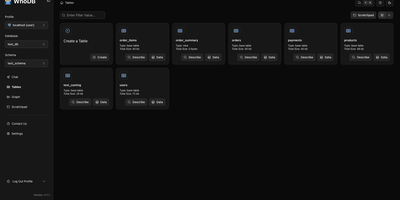
With nearly 5,000 GitHub stars earned in under two years, WhoDB has rapidly emerged as the lightweight alternative to heavyweight database clients like DBeaver and DataGrip by delivering a sub-50MB binary that starts in under a second and connects to 18+ database systems from a single interface. The Go backend serves the React and TypeScript frontend with table virtualization for efficient rendering of large result sets, lazy loading, and query result streaming that keeps the interface responsive even when browsing tables with millions of rows. The Community Edition connects to PostgreSQL, CockroachDB, YugabyteDB, MySQL, MariaDB, TiDB, SQLite, DuckDB, MongoDB, FerretDB, Redis, Valkey, Dragonfly, Elasticsearch, OpenSearch, ClickHouse, QuestDB, and Memcached through a unified credential selector that switches between databases with minimal configuration. Interactive schema diagrams render entity-relationship graphs showing table structures, foreign keys, and column types for visual database exploration. The Jupyter-style query scratchpad provides SQL autocomplete, syntax highlighting, and multi-statement execution with paginated results. AI integration optionally connects to Ollama, OpenAI, Anthropic, LM Studio, or any OpenAI-compatible provider for natural language database queries — ask questions in plain English and receive generated SQL. Data management includes inline row editing, CSV export, and filtered data views. Docker deployment runs a single container exposing port 8080. Running on a dedicated VPS on RepoCloud with guaranteed CPU, RAM, and SSD, full root SSH access, and a browser serial console. Apache-2.0 licensed.
Grimoire
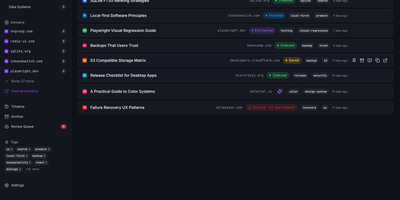
Grimoire captures, extracts, and indexes the content behind your bookmarks so you can search what pages actually say, not just their titles and URLs. The ingestion pipeline accepts links from the web UI, REST API, MCP server, browser bookmarklet, or bulk import, then fetches each page and extracts readable content using specialized parsers for GitHub repos, GitHub issues, StackOverflow threads, YouTube transcripts, PDFs, and standard web articles. Everything stores locally in SQLite with file-based content archives. Search operates in three modes: FTS5 keyword matching for exact terms, semantic embedding search for meaning-based retrieval using vector similarity, or a hybrid ranking mode combining both. Optional AI providers including OpenAI, Ollama, Anthropic, DeepSeek, and any OpenAI-compatible endpoint generate automatic tags, summaries, and embeddings without being required for core functionality. The interface built with React 18, Vite, TypeScript, Tailwind CSS, and Radix UI supports categories, nested tags, notes, archive and trash states, read-later flags, and multi-user isolated spaces. A single Bun-powered Hono process serves both the compiled frontend and the REST API on port 3210, requiring only one Docker container and a SQLite volume. Backup and restore export bookmarks, content, settings, and metadata as portable ZIP archives. Nearly 3,000 GitHub stars reflect growing adoption among developers and researchers. Running on a VPS on RepoCloud with guaranteed CPU, RAM, and SSD, full root SSH access, and a browser serial console. MIT licensed.
Swetrix
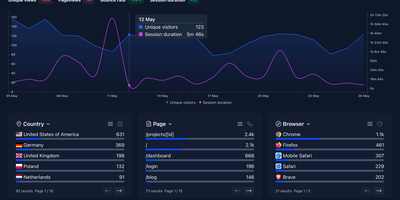
Traffic analytics, real-user performance monitoring, and client-side error tracking - normally three tools - in one cookieless, privacy-first dashboard: Swetrix. The Community Edition ships the same core engine as the cloud product - a NestJS API with ClickHouse for high-volume event storage, MySQL for relational data, and Redis for caching, fronted by a React dashboard and a ~5 KB tracking script with official packages for 20+ frameworks including Next.js, WordPress, and Shopify. Traffic analytics cover pageviews, referrers, UTM campaigns, geolocation, sessions with page flows, funnels, and custom events - all anonymized server-side with no cookies, no cross-device tracking, and no consent banner required for GDPR compliance. Performance monitoring records real-user metrics per pageview: TTFB, DNS and TLS timing, and render times, so regressions surface in the same place as traffic. Error tracking captures unhandled JavaScript exceptions automatically with formatted stack traces, filename/line metadata, affected browsers and pages, first/last-seen timestamps, and a resolve workflow - replacing a separate error monitoring subscription for many teams. Alerts fire to email, Slack, Telegram, Discord, or webhooks on traffic spikes, new errors, and custom events. If Plausible covers your traffic questions but you also want to know why the site broke, Swetrix answers both.

Stormkit
Stormkit delivers a self-hostable PaaS that eliminates vendor lock-in while providing Vercel-class deployment workflows. The Go backend handles build orchestration, hosting, and background job processing while the React frontend provides a complete management dashboard for applications, environments, and team collaboration. Git integration with GitHub, GitLab, and Bitbucket enables push-to-deploy workflows where every commit triggers automated builds with preview links posted directly to pull requests. Serverless functions use filesystem-based routing — each TypeScript or Node.js file in the API directory becomes an endpoint automatically, deploying to AWS Lambda with configurable timeouts. PostgreSQL database schemas ship with automatic migrations, isolated credentials per environment, and secure environment variable injection preventing credential leakage between staging and production. Custom domains provision TLS certificates automatically through Let's Encrypt with support for custom certificates and headers. The environment system creates isolated deployment contexts for production, staging, and development with independent variables, domain bindings, and auto-publish rules per branch. Privacy-respecting server-side analytics track visitors, referrers, and top paths without client cookies or third-party scripts. Role-based access control manages team permissions across applications. Docker Compose deployment provisions the full stack including the API server, hosting service, build runner, and worker server. Running on a dedicated VPS on RepoCloud with guaranteed CPU, RAM, and SSD, full root SSH access, and a browser serial console. AGPL-3.0 licensed.

Open Agent Builder
Open Agent Builder delivers a visual canvas for orchestrating AI agent workflows without writing Python scripts or managing complex codebases. The React Flow-powered drag-and-drop interface supports seven node types — Agent, Scraper, Transform, If/Else, Loop, User Approval, and MCP Tool — each configurable with provider-specific settings for Anthropic Claude (Haiku 4.5 and Sonnet 4.5), OpenAI GPT-5, Groq, or any OpenAI-compatible endpoint. The LangGraph orchestration engine handles state management, conditional routing, and human-in-the-loop approval gates while Firecrawl integration converts any website into structured, LLM-ready data through scrape, crawl, and map operations. E2B sandboxed code execution powers Transform nodes for secure data manipulation without risking host system integrity. Real-time streaming updates show execution progress node-by-node as workflows run, with Convex providing reactive database synchronization for workflow state and execution history. The TypeScript-first architecture (96.8% TypeScript) built on Next.js 16 App Router with Tailwind CSS delivers a responsive interface across devices. Clerk handles multi-user authentication with JWT integration for secure workspace isolation. Deploy via npm install and environment configuration with Firecrawl, Convex, and Clerk API keys. Running on a dedicated VPS on RepoCloud with guaranteed CPU, RAM, and SSD, full root SSH access, and a browser serial console. MIT licensed.