Sage Wiki
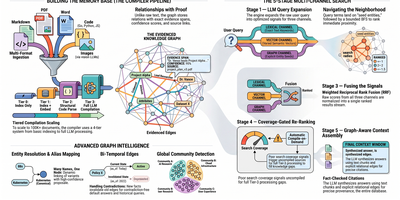
Sage Wiki turns a pile of unstructured documents into a fully interlinked, searchable wiki by running them through a five-pass LLM compiler pipeline. Inspired by Andrej Karpathy's vision of LLM-compiled knowledge bases, the pipeline processes source files through diff detection, summarization, concept extraction, image captioning, and cross-reference discovery, with parallel LLM calls and checkpoint/resume for vaults scaling to 100,000+ documents. The typed ontology graph stores entities and relations with BFS traversal, configurable relation types, multilingual synonyms, and a promotion/demotion lifecycle backed by grounding verification and consensus scoring. Multi-format ingestion handles Markdown, PDF, Word, Excel, PowerPoint, EPUB, email, CSV, images, and code files without manual tagging. LLM provider support spans Anthropic, OpenAI, Gemini, Ollama, and any OpenAI-compatible API, with per-pass model routing enabling cost optimization by assigning cheaper models to simpler tasks. The built-in MCP server exposes 17 tools over SSE transport for integration with Claude, Cursor, and any MCP-compatible agent, while native Obsidian vault overlay ensures existing note workflows remain undisrupted. Team deployment supports Git-synced shared wikis, centralized server access, and hub federation across multiple projects. Ships as a single Go binary with Docker Compose multi-arch images serving the web UI on port 3333. Running on a dedicated VPS on RepoCloud with guaranteed CPU, RAM, and SSD, full root SSH access, and a browser serial console. MIT licensed.
Observal
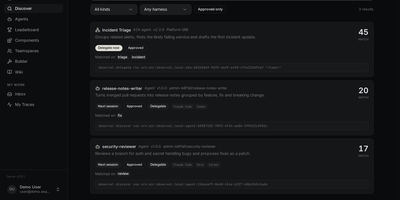
To pull a team's skills, MCP servers, hooks, prompts, and agent files out of scattered Git repositories, Observal keeps them in one reviewed registry and traces real sessions to show which ones help. Build an agent visually, with a live config preview for every harness. Submissions wait in an admin review queue, where reviewers inspect side-by-side version diffs before approving a release. Teamspaces give each team its own namespace, and approved releases can be forked into independent drafts. One pull command then writes the right config for Claude Code, Cursor, Kiro, Codex, Copilot, Pi, OpenCode, Antigravity, or Goose. Every approved resource is discoverable through the open Agentic Resource Discovery standard, and a running agent can hand part of its task to another approved agent or a remote Agent2Agent service. Hooks record each session as a trace of prompts, tool calls, MCP round trips, tokens, and errors, with turn-by-turn replay for debugging and audits. Insight reports, generated through providers such as Anthropic, OpenAI, or Ollama, list what is working, what is hindering, and quick wins. A dashboard follows adoption, cost, and department usage, a leaderboard ranks agents by downloads, and audit logs, SAML single sign-on, and SCIM provisioning are included. Running on a dedicated VPS on RepoCloud with guaranteed CPU, RAM, and SSD, full root SSH access, and a browser serial console. Apache-2.0 licensed.
Agentic Resource Registry
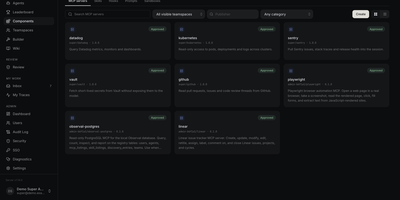
Every team building with coding agents has the same drawer problem: the best Skill, MCP server, or agent file lives in one person's repo, undocumented, while three colleagues rebuild it from scratch. Agentic Resource Registry is the internal catalog that ends the duplication, a self-hosted registry where your organization publishes Skills, MCP servers, hooks, prompts, agent files, and sandboxes in one searchable place. Browse by teamspace, publisher, category, or harness and see at a glance what each resource supports and how often it has been pulled. Authors build agent files in a four-step builder with a live summary and draft readiness checks, then submit them into a review queue where admins inspect the full prompt and version diffs before approving. Forking an approved release creates your own draft with pinned components, and reviewers can compare it against upstream line by line. The companion CLI installs any approved resource into Claude Code, Cursor, Codex, Kiro, Copilot, OpenCode, Pi, and more, generating the correct config for each harness automatically. Approved resources are also discoverable over the open ARD standard, so a running agent can hand part of its task to another approved agent or a remote A2A service. Running on a dedicated VPS on RepoCloud with guaranteed CPU, RAM, and SSD, full root SSH access, and a browser serial console. Apache-2.0 licensed.
Kanzo
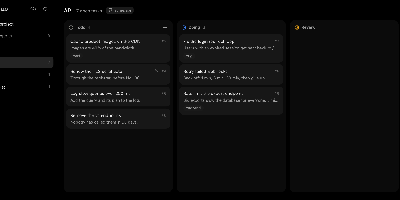
Give your coding agents a board they can work, not just read: Kanzo is a self-hosted kanban board where you and your agents move the same tasks through the same columns at the same time. Tell an agent to take the next task and it moves the card to doing, comments as it works, and leaves the result where you can read it in the browser. Projects follow the code automatically: the agent finds the right board from the Git remote of the repository it is working in, and you can link more repositories to a project from its menu. Press n to add a task, search every project with a slash or Command-K, paste an image straight into a card or comment, and park half-formed ideas in an optional Backlog column that agents leave alone until you promote them. The whole board is one folder, and a private Git repository you own keeps it in step across a laptop, a desktop, and a Raspberry Pi, with conflicts resolved by choosing which side to keep. Statuses are yours to rename in the config file, the board exports cleanly to Markdown or JSON, and one click in the sidebar installs updates and restarts the service. Running on a dedicated VPS on RepoCloud with guaranteed CPU, RAM, and SSD, full root SSH access, and a browser serial console. AGPL-3.0 licensed.
Nightingale
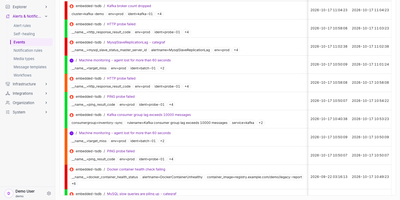
When a query crosses its threshold, Nightingale, a self-hosted alerting engine, decides who hears about it and how, without moving data out of the stores you already run. Rules use PromQL, log queries, or SQL against Prometheus, VictoriaMetrics, Elasticsearch, Loki, ClickHouse, MySQL, or PostgreSQL, graded S1, S2, or S3 with a for-duration that absorbs brief spikes. Existing Prometheus alert rules import from YAML. Business groups give each team its own rules and dashboards, and sign-in works through OIDC, OAuth2, LDAP, or CAS. Once a rule fires, mute rules silence the noise, subscriptions add recipients, and event pipelines rewrite labels or route conditionally. Delivery reaches Slack, PagerDuty, Discord, Telegram, Jira, email, DingTalk, Feishu, WeCom, SMS, and voice calls, plus HTTP webhooks and scripts for anything else. Evaluation records, active and historical events, and notification results show what happened at each step. If an alert misbehaves, the built-in AI agent explains why it fired or never arrived, and it drafts rules, dashboards, and mutes from plain-language requests. Claude Code, Cursor, and other MCP clients can query alerts and manage alerting through /mcp, read-only by default and bound by the caller's own permissions. At remote sites, n9e-edge keeps evaluating and notifying when the link to the center drops. Running on a dedicated VPS on RepoCloud with guaranteed CPU, RAM, and SSD, full root SSH access, and a browser serial console. Apache-2.0 licensed.
Infinite Canvas
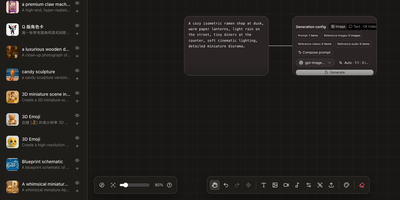
Instead of juggling a chat window, a folder of reference images, and a notebook of half-remembered prompts, Infinite Canvas puts the whole image-making process on one zoomable board. Drop in text, image, video, and generation-settings nodes, then wire them together so every result stays connected to the prompt and references behind it. Add one or several OpenAI-compatible endpoints, choose default text, image, and video models, and set image count, aspect ratio, quality, and transparent backgrounds per node. Batch results arrive as linked nodes that remember their prompt, model, and dimensions, so any of them can be retried later with the same settings. A prompt library searches seven built-in sources plus your own JSON sources and inserts the winner straight onto the board. An asset shelf keeps reusable images, clips, and audio within reach. Projects can be duplicated, exported, and synced between devices over WebDAV. Want a helper? A local Canvas Agent lets Codex read the active board and edit it through MCP, with approvals and permissions shown in a side panel. Plugins add node types, inspectors, and toolbar actions. Running on a dedicated VPS on RepoCloud with guaranteed CPU, RAM, and SSD, full root SSH access, and a browser serial console. MIT licensed.
Nanobot
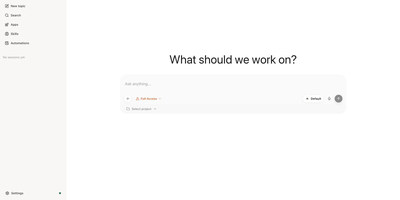
With over 46,000 GitHub stars, nanobot is the ultra-lightweight personal AI agent framework that delivers full agentic capabilities — tools, persistent memory, multi-agent workflows, scheduled automation, and 10+ chat channel integrations — in approximately 4,000 lines of readable Python core code. The agent loop receives messages from any connected channel, builds context from session history and long-term memory files, calls the configured LLM provider, executes requested tools, and publishes replies back to the originating channel. Supported LLM providers include OpenAI, Anthropic, Google Gemini, DeepSeek, Qwen via DashScope, Moonshot/Kimi, Ollama, vLLM for local models, and any OpenAI-compatible API through OpenRouter or LiteLLM. Chat channels connect the agent to Telegram, Discord, Slack, WhatsApp, Feishu/Lark, DingTalk, Email via IMAP/SMTP, QQ, Matrix with end-to-end encryption, Mattermost, and the built-in browser WebUI served from the published Python wheel with no separate frontend build. Built-in tools include filesystem read/write/edit, shell execution with configurable sandboxing via bubblewrap, web search and fetch with SSRF protection, MCP server integration, cron scheduling, image generation, and subagent spawning for parallel task delegation. The Dream memory system consolidates session history into persistent markdown files for long-term context retention across conversations. Deployment runs as a CLI agent, a persistent gateway server, a Docker container with Docker Compose, or an OpenAI-compatible API server. Running on a dedicated VPS on RepoCloud with guaranteed CPU, RAM, and SSD, full root SSH access, and a browser serial console. MIT licensed.
OpenTakeoff
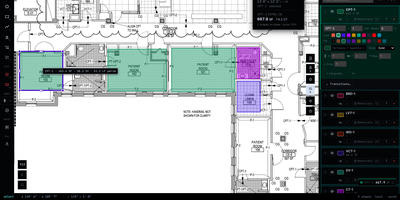
From a PDF plan set to a waste-adjusted material order takes one browser tab: OpenTakeoff measures floors, walls, and fixtures at the drawn scale and never uploads a single drawing. Drag in a PDF, image, or zip plan set, view up to four sheets side by side, and search sheet text, while stitching joins floors split across a match line. Scale comes from the drawn scale note or a known dimension, and a check tool reports percent error before a wrong scale can skew a bid. Area, linear, and count tools carry condition colors, CAD hatches, waste percentages, and wall heights, and a marquee over the architect's finish schedule turns approved rows into conditions. Supporting materials convert coverage rates into rounded-up order quantities, and roll-goods mode lays out lanes, seams, and cuts to scale. Totals in SF, SY, LF, and EA export to CSV, JSON, Excel, print, or a marked-set PDF, while named revisions compare addenda as quantity deltas. Highlighters, revision clouds, callouts, and notes mark up sheets on a layer that is never counted, and dimension lines label measured lengths at the sheet scale. An MCP server with more than 50 tools lets AI agents open plans, set scale, and measure rooms, and each shape they draw stays a dashed proposal until a person accepts it. Running on a dedicated VPS on RepoCloud with guaranteed CPU, RAM, and SSD, full root SSH access, and a browser serial console. AGPL-3.0 licensed.
Activepieces
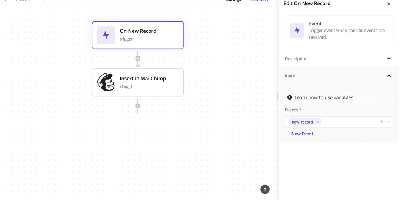
Zapier's job, on your own server: Activepieces is an open-source workflow automation platform built to be exactly that replacement. Flows are built in a visual no-code editor with triggers, actions, loops, conditional branches, auto-retries, raw HTTP steps, and code steps that run JavaScript or TypeScript with full npm package support. Integrations are "pieces" - type-safe TypeScript npm packages with hot reloading for local development - and the catalog spans 600+ services, with the large majority contributed by the community. The platform is AI-first in two directions: native AI pieces call OpenAI, Anthropic, Google, and Azure models inside flows, and every piece automatically doubles as an MCP server, so assistants like Claude Desktop and Cursor can invoke your integrations and workflows through natural language. A built-in MCP server also exposes 30 tools for building flows, managing tables, and running tests agentically. Flows are fully versioned with draft and locked states. The core is MIT-licensed and runs on TypeScript with PostgreSQL and Redis.
Fusio
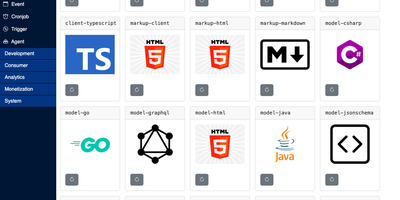
Fusio turns the data and services you already run into a managed API that partners, apps, and AI agents can actually use. The workflow starts small: add a database connection and a table becomes a REST endpoint, or proxy a remote service and route traffic between internal microservices. Each operation pairs an HTTP path with an action and a schema, so requests are validated and an OpenAPI specification plus client SDKs for major languages come out without extra effort. Custom behavior lives in reusable actions, and an AI assistant can draft actions and schemas from a plain-language prompt. Native Model Context Protocol support then offers those actions to autonomous agents as tools. Third-party developers get a self-service portal with documentation, testing tools, and their own keys. Every endpoint can be protected with scopes and rate limits. Asynchronous work runs through events, webhooks, cronjobs, and triggers. When the API becomes a product, plans, quotas, and transactions handle billing, and analytics follow usage, performance, and errors. A marketplace installs ready-made actions and apps, and the generator and test panels speed up development. Running on a dedicated VPS on RepoCloud with guaranteed CPU, RAM, and SSD, full root SSH access, and a browser serial console. Apache-2.0 licensed.
ToolHive
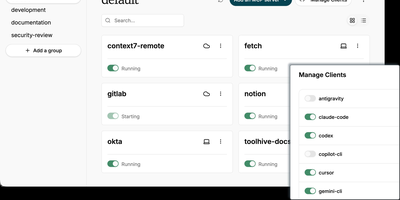
ToolHive is an open-source MCP server management platform that lets you run, secure, and orchestrate Model Context Protocol servers in isolated containers, giving AI agents structured access to tools like GitHub, databases, and cloud services without exposing host credentials or network. Every server launches inside its own sandboxed container with a minimal permission file, network access filtering, and encrypted secrets management, preventing misbehaving connectors from reaching beyond their defined scope. The built-in registry provides a catalog of vetted servers you can install with one command, while custom images and package-manager references let you onboard proprietary connectors without writing Dockerfiles. Platform teams deploy the Kubernetes operator to declare MCP servers as cluster resources using Custom Resource Definitions, with automated lifecycle management and multi-namespace isolation. The Virtual MCP Server gateway aggregates multiple backends behind a single endpoint, centralizing OIDC authentication, tool filtering, and composite cross-server workflows so clients connect once instead of juggling separate URLs. An MCP Optimizer analyzes tool schemas via semantic search and surfaces only relevant tools per request, cutting token consumption by up to 85%. OpenTelemetry traces and Prometheus metrics deliver full visibility into tool execution, latency, and request audit trails across every managed server. Running on a dedicated VPS on RepoCloud with guaranteed CPU, RAM, and SSD, full root SSH access, and a browser serial console. Apache 2.0 licensed.
BlogFactory
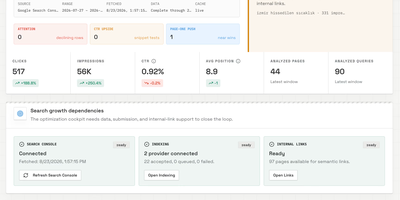
BlogFactory is the first open-source agent control plane purpose-built for multi-site content operations, shipping 16 distinct capabilities across four operational pillars — Operate, Grow, Control, and Deliver — in its v0.1.0 release. The platform keeps source evidence, AI-generated drafts, revisions, SEO metadata, human review, preflight checks, and CMS delivery destinations in one workspace while enforcing a server-side authority ceiling that prevents agents from ever publishing live content, accessing credentials, or performing administrative actions. AI agents connect through a Streamable HTTP MCP endpoint with OAuth authentication and site-scoped tool discovery, compatible with Codex, ChatGPT, and any MCP-capable client. Content creation supports single articles from keywords, titles, URLs, PDFs, text, or YouTube sources, batch campaigns, and programmatic content via reusable templates with structured data rows. The Search Growth module connects Google Search Console complete-day data to ranked optimization opportunities, 30-day growth plans, content classification by signal type (growing, low-CTR, almost-ranking, page-two, zero-click), indexing checks, and semantic internal-link suggestions. Brand Voice separates global voice rules, writer profiles, knowledge context, and brand guidelines from article mechanics. Approved drafts are delivered as CMS drafts to WordPress, Ghost, Wix, or Framer through idempotent, optimistic-locking-protected handoffs with explicit destination selection and preflight validation. The stack runs on React/Vite, a Hono/TypeScript API, PostgreSQL, and MinIO via Docker Compose, with providers including OpenRouter, OpenAI, and Google services under a bring-your-own-AI model. Running on a dedicated VPS on RepoCloud with guaranteed CPU, RAM, and SSD, full root SSH access, and a browser serial console. AGPL-3.0 licensed.
Engraphis
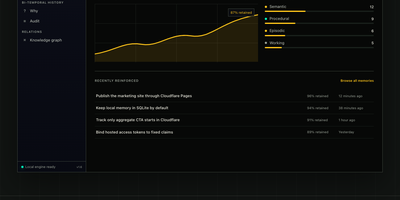
Engraphis is a durable memory layer for coding agents that answers questions like what did we decide about the auth layer three weeks ago, and why, with inspectable project memory that survives across sessions and repositories instead of evaporating when a chat ends. Store a decision once and recall it later in a new session, scoped by workspace, repository, and session so one project's facts never leak into another's context. Recall blends vector, lexical, graph, and code-aware retrieval, then packs the strongest evidence into a hard context budget your agent can actually use. Every returned fact keeps its provenance attached, and the engine cites its support or abstains when the evidence is too weak to trust. Facts are never silently overwritten: bi-temporal history preserves earlier versions, and a timeline view surfaces superseded knowledge when you need to know what used to be true. Index a repository into a code-symbol graph and ask what calls a function before you change it. Conflicting or quarantined memories wait in a review queue for a human decision. Running on a dedicated VPS on RepoCloud with guaranteed CPU, RAM, and SSD, full root SSH access, and a browser serial console. Apache 2.0 licensed.
prest
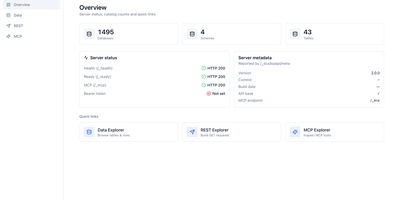
pRESTd points at your PostgreSQL or MySQL database and instantly serves every table as a REST API, so the CRUD backend you were about to spend a week writing already exists. Every table answers at its own address with filtering, ordering, pagination, and column selection in the query string, and batch endpoints group several operations into one call. When a table endpoint is not enough, drop a SQL file into the queries folder and it becomes a named route with bound parameters, or store the scripts in the database and manage them through the admin API. Turn on the auth module and the server issues JWTs from your own users table, checks them on every route, and enforces table-level permissions so public tables stay open while payroll stays shut. The same database also appears as a read-only MCP endpoint, which lets Claude, Cursor, and other AI clients discover your tables and query them with your permissions instead of a copied export. One process can front several databases at once, Postgres and MySQL side by side, each under its own alias for tenants or reporting replicas. An embedded Studio in the same binary browses the catalog and rows, builds GET requests, and invokes MCP tools, so you can inspect everything from the browser before writing a line of client code. Running on a dedicated VPS on RepoCloud with guaranteed CPU, RAM, and SSD, full root SSH access, and a browser serial console. MIT licensed.
OpenFlowKit
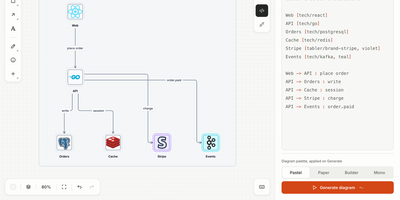
Draw it, write it as code, or hand it to your AI agent: OpenFlowKit is an open-source diagram canvas where the picture and the text behind it are always the same diagram. Drag shapes on the canvas or type a few forgiving lines, and each side regenerates the other as a single undo step. Ten diagram types share that one language: architecture with C4 views and cloud icons, sequence, flowchart, entity-relationship, state, class, mind maps, git graphs, charts, and wireframes. Paste Mermaid, Structurizr, or D2 and it converts into editable shapes, and Copy as Mermaid sends a flowchart or sequence back out for your README. Paste a GitHub repository instead and Map mode draws its architecture for you, with every arrow citing the exact file and line behind it, and a CLI that maps a local checkout for private repos. Connect Claude Code, Cursor, or any MCP client and the agent draws on your live canvas, restyles what is there, and screenshots its own work to check it. A built-in assistant works with your own key from Claude, OpenAI, Gemini, Groq, Mistral, OpenRouter, or a local Ollama, and exports cover PNG, SVG, PDF, JSON, and animated SVG, GIF, MP4, or WebM you can drop into documentation. Running on a dedicated VPS on RepoCloud with guaranteed CPU, RAM, and SSD, full root SSH access, and a browser serial console. MIT licensed.

Hatchdoor
Hatchdoor gives your Markdown notes two front doors at once: a fast web interface for you, and an MCP endpoint where AI agents read and edit the very same vault. Point it at any folder of Markdown files, an existing Obsidian vault included, and it indexes everything into a disposable SQLite read model that rebuilds itself from your files if deleted. In the browser you browse folders, follow wikilinks that survive renames, explore backlinks and graph views, and search by keyword or meaning across every vault you mount. The live editor shows Markdown syntax only on the line you are editing and saves automatically, while concurrency checks refuse a save when the note changed underneath you. Agents connect with their own token and start read-only; turn writes on and Claude Code, Codex, Cursor, or Hermes can create, edit, move, and link notes through the same checked operations the interface uses. Saved queries in Obsidian's Bases syntax render as live tables, attachments preview inline, and optional git integration commits and pushes every change back to your vault's repository. Running on a dedicated VPS on RepoCloud with guaranteed CPU, RAM, and SSD, full root SSH access, and a browser serial console. AGPL-3.0 licensed.
Whirl
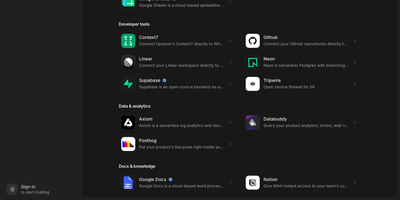
Whirl puts every top AI model in a single conversation and remembers what you were working on last week, so you can switch models mid-thought without losing the thread. Ask for a report, a chart, or a small interactive page and it appears as a living artifact in a side panel, still editable while you keep chatting, and shareable by link when it is ready to leave the conversation. Connect your own tools over MCP, with OAuth sign-in handled for you, or install skills that teach the app new tricks your team relies on. Long-term memory carries your preferences and project context from chat to chat, and live web search with page reading grounds answers in today's pages instead of the model's training data. Sensitive threads can be locked with a password that encrypts them on your device, where the server never sees the key and only zero-retention models may answer. Around those headline pieces sits the everyday kit: incognito mode, a message queue for when you think faster than the model replies, voice input, image generation, file attachments, folders, and sharing controls. An admin console manages the model catalog, integrations, and skills, and the interface itself switches between light and dark with your choice of accent color, installable as a mobile web app. Running on a dedicated VPS on RepoCloud with guaranteed CPU, RAM, and SSD, full root SSH access, and a browser serial console. MIT licensed.
Rustunnel
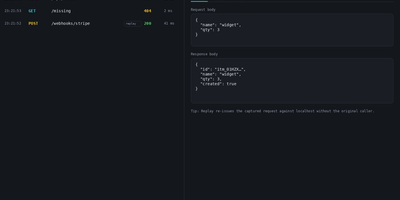
Rustunnel turns a service running on your laptop or private network into a public HTTPS, TCP, or UDP endpoint without opening inbound ports on the machine where it lives. Point the client at a local port and share the public address for webhook testing, a quick demo, an AI agent tool, SSH access, a game server, or an IoT device that cannot accept inbound connections. Give tunnels custom subdomains on your own wildcard domain, terminate HTTPS with automatic Let's Encrypt certificates, and keep client traffic encrypted from edge to local service. Put several backends behind one subdomain or TCP port and let TCP or HTTP health probes remove sick members before visitors hit them. When two peers can reach each other directly, start a P2P tunnel with NAT hole punching and QUIC, with relay fallback when the direct path fails. Watch sessions, tunnel health, traffic, and request logs from the live dashboard, inspect headers and bodies in the local request inspector, and replay a captured call while debugging a webhook. Manage tunnels, tokens, groups, captured requests, and history through the REST API, scrape Prometheus metrics, review audit logs, or let an MCP-compatible coding assistant create and close tunnels in plain language. Running on a dedicated VPS on RepoCloud with guaranteed CPU, RAM, and SSD, full root SSH access, and a browser serial console. AGPL-3.0 licensed.