Openship
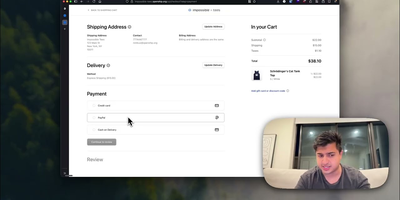
Point Openship at a GitHub repo, local folder, or prebuilt artifact and it detects your stack, builds a Docker container, provisions databases, configures domains with automatic Let's Encrypt TLS, and routes traffic through an OpenResty edge layer on ports 80 and 443. Already past 10,000 stars since launching in March 2026, it turns any Linux VPS into a managed application host. Language support covers Node.js, Python, Go, Rust, PHP, Ruby, Java, .NET, Docker, and monorepo projects with push-to-deploy CI/CD, pull request preview environments on unique subdomains, staging/production flows, and one-click rollbacks. Integrated backend services include managed Postgres, MySQL, MongoDB, Redis, persistent volumes, WebSocket proxying, object storage, and worker processes, all provisioned from the dashboard without compose files. A built-in SMTP server handles transactional email with automatic DKIM, SPF, and DMARC configuration, eliminating external email services. The edge layer serves HTTP/3 with Brotli compression, configurable cache rules, and instant purging. Real-time monitoring streams build logs, container metrics, visitor geography, and per-status-code analytics at 1.4 microsecond overhead with zero database writes. Scheduled backups cover databases and volumes with one-click restore and export. Three interfaces (web dashboard, desktop app for macOS/Windows/Linux, and the openship CLI) drive the same API, plus a Model Context Protocol endpoint for AI integration. Running on a dedicated VPS on RepoCloud with guaranteed CPU, RAM, and SSD, full root SSH access, and a browser serial console. Apache 2.0 licensed.
Kavita
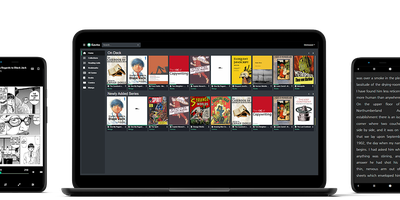
Manga, comics, ebooks, and light novels get a streaming-service-style home in Kavita - a fast, cross-platform reading server for the DRM-free collection you share with family and friends. It natively serves CBZ, CBR, CB7, ZIP/RAR/7z archives, raw images, EPUB, and PDF, with hand-crafted web readers per format: webtoon scrolling, single and dual-page spreads with advanced caching for the comic reader, and a book reader with adjustable fonts, spacing, margins, color themes, and column modes. Reading progress tracks per user, so everyone resumes exactly where they stopped on any device. Metadata parses from filenames, ComicInfo.xml, and EPUB fields, feeding index-backed search, smart filters, collections, reading lists with CBL import, and Want to Read queues. Role-based user management covers age restrictions, per-library access, and OIDC authentication. An OPDS feed connects third-party clients - Panels on iOS, Librera on Android, KOReader on e-ink devices - and a comprehensive REST API supports custom integrations. EPUB annotation and highlight support, custom theming, and full localization round it out. Built with .NET and Angular, it handles 50,000+ file libraries without strain; optional Kavita+ adds AniList scrobbling, recommendations, and external metadata.
Hindsight
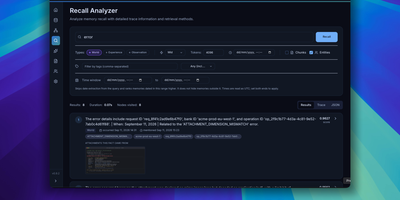
Memory that survives the session: Hindsight extracts facts, entities, and timestamps from everything an AI agent retains, then lets the agent search or reason over it later. Adding it to an existing LLM client takes a two-line wrapper, and more than 60 integrations cover Claude Code, Cursor, LangGraph, CrewAI, and n8n. Every bank also exposes its own MCP endpoint. Retain sends text, images, or files through an LLM that extracts facts, timestamps, entities, and relationships. Recall runs semantic, keyword, graph, and temporal searches in parallel, merges them with reciprocal rank fusion, reranks with a cross-encoder, and trims to a token budget. Reflect reasons across memories for questions that need synthesis, shaped by per-bank skepticism, literalism, and empathy traits. In the background, related facts consolidate into observations that keep exact quotes and proof counts and are refined, never silently overwritten. Mental models and wiki-style knowledge pages hold standing answers that rewrite themselves as the bank learns. Each user, agent, or project gets an isolated bank with no cross-bank leakage, and Memory Defense redacts or blocks secrets and PII against 45 patterns. The Control Plane adds a Recall Analyzer with traces, a memory constellation graph, and a knowledge page editor. Extraction and reasoning can run on 25+ LLM providers, including local Ollama and llama.cpp. Running on a dedicated VPS on RepoCloud with guaranteed CPU, RAM, and SSD, full root SSH access, and a browser serial console. MIT licensed.
Open Compute
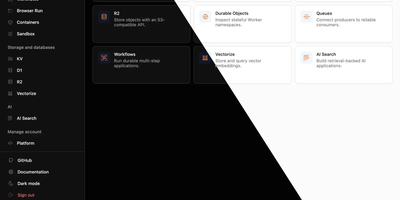
Open Compute is a self-hosted Cloudflare Workers-compatible platform that runs your Workers, storage, and AI services on hardware you own, from one binary and one daemon. Deploy the Worker code you already wrote with its config file and framework adapters, then roll back to an earlier immutable deployment when a release misbehaves. Serve traffic locally or over HTTPS through the shared Gateway, with routes you control instead of a vendor account. Each instance stays isolated with its own data directory and credentials, while you switch between registered instances from the same operator view. Bindings cover the platform pieces applications actually need: key-value data, SQL databases, object storage, stateful objects, queues, durable multi-step workflows, scheduled cron, cache, vector search, and AI search. Logs and a live tail show what running Workers are doing right now, and health, backup, and recovery workflows keep a single machine manageable without a cluster. Verified upgrades roll back automatically when something fails, and object bytes can move to S3-compatible storage when local disk is no longer enough. Running on a dedicated VPS on RepoCloud with guaranteed CPU, RAM, and SSD, full root SSH access, and a browser serial console. Apache-2.0 licensed.
Radarr
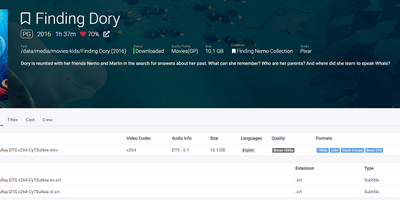
The movie half of the *arr stack: Radarr is a .NET collection manager that automates acquiring films for Usenet and BitTorrent users the way Sonarr does for TV. Add a movie once and Radarr handles the rest: it monitors indexers and RSS feeds, grabs a matching release the moment one appears, sends it to SABnzbd, NZBGet, qBittorrent, Deluge, Transmission, rTorrent, or another connected download client, then imports, sorts, and renames the file into your library structure. Quality profiles are the control surface - define allowed resolutions and a cutoff, and Radarr keeps upgrading files automatically, replacing a DVD rip when a Blu-ray release lands. Custom formats go further, scoring releases by codec, HDR metadata, release group, streaming source, or arbitrary regex so the copy you want always wins the pick. Failed downloads retry with another release automatically; a manual search shows every candidate and explains why one was skipped. Release parsing recognizes director's cuts, special editions, AKA titles, and hardcoded subs. Plex and Kodi integration handles notifications, library refreshes, and metadata like posters, trailers, and subtitles, and a calendar view tracks upcoming releases. It pairs naturally with Jellyseerr for request management and shares its API conventions with the whole *arr ecosystem.
Zabbix
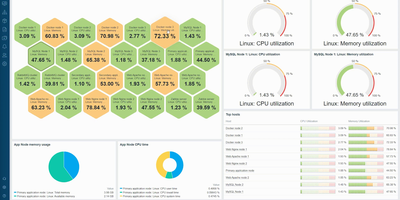
Monitoring everything from network switches to Kubernetes clusters since 2001 with over 6,200 GitHub stars and deployments exceeding 100,000 devices per installation, Zabbix has established itself as one of the most mature and feature-rich open-source monitoring platforms available, trusted by organizations including Dell, Salesforce, ICANN, and T-Mobile. The platform collects metrics from virtually any source using Zabbix Agent written in C, Zabbix Agent 2 written in Go with native plugin support, SNMP v1/v2c/v3 polling and trapping, IPMI for hardware health, JMX for Java applications, SSH and Telnet checks, HTTP/HTTPS polling, and ODBC database queries. Version 7.0 LTS introduced synthetic browser monitoring that executes user-defined JavaScript via WebDriver to simulate multi-step user interactions on websites, proxy load balancing with automatic host redistribution across proxy groups for high availability, in-memory proxy data buffering delivering up to 100x performance improvement, native multi-factor authentication with TOTP and Duo support, and just-in-time user provisioning from SAML and LDAP. Low-level discovery automatically detects file systems, network interfaces, SNMP OIDs, VMware resources, and Kubernetes pods, creating monitoring items and triggers dynamically. The alerting engine correlates events with configurable escalation chains, sending notifications through Slack, Microsoft Teams, PagerDuty, Jira, email, and SMS with customizable message templates. Over 1,000 official templates provide instant monitoring for Linux, Windows, VMware, AWS, Azure, Docker, PostgreSQL, MySQL, Apache, Nginx, and hundreds more. Running on a dedicated VPS on RepoCloud with guaranteed CPU, RAM, and SSD, full root SSH access, and a browser serial console. AGPL-3.0 licensed.
Ether
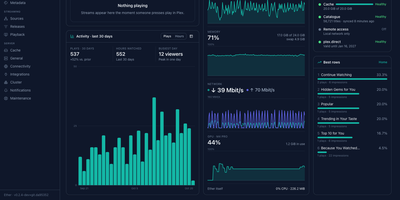
One Ether install puts the TMDB catalogue inside your TV apps and streams titles on demand from your own accounts, holding no media files at all. It appears as a normal server inside the Plex, Jellyfin, Emby, Infuse and Stremio apps your household uses, with the whole catalogue browsable as if it were local. Press Play and Ether resolves the best release across your sources, health checks it, and streams only the byte ranges the player asks for, so scrubbing lands at the right keyframe instead of restarting a download. Pull titles from Real-Debrid, TorBox, AllDebrid and Premiumize accounts, Usenet providers through a built-in Newznab and Torznab manager, Cardigann definitions, or Stremio stream addons pasted in as sources. Released titles need no request queue: each viewer's Plex and Trakt watchlists sync in, and newly playable titles surface in a Now Available row on their home screen. A poster studio renders 4K, Dolby Vision, Atmos and rating badges onto artwork in the browser, and rule-based collections can run as 24/7 virtual channels in the Live TV guide. Subtitles arrive matched and retimed to the cut playing, with skip markers. A self-evicting cache keeps replays instant and preloads the next episode as you watch. Local playback needs no Plex Pass, and Docker runs Ether on port 32400 beside your library rather than replacing it. Running on a dedicated VPS on RepoCloud with guaranteed CPU, RAM, and SSD, full root SSH access, and a browser serial console. GPL-3.0 licensed.
FileBrowser Quantum
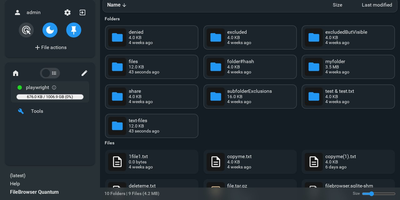
FileBrowser Quantum is an open-source, self-hosted web file manager that transforms any directory tree or mounted storage volume into a fast, searchable cloud drive accessible from any browser. You can mount multiple independent filesystem sources at once and apply custom include or exclude rules to keep sensitive system folders hidden from everyday browsing. A background indexing engine powers instant as-you-type search across millions of files, letting you filter results by file size, folder size, media type, or modification date in milliseconds. Rich media thumbnails render automatically for videos, office documents, audio album artwork, and interactive 3D models, while integrated OnlyOffice support lets you edit spreadsheets and word processing documents directly inside your browser tab. Built-in WebDAV server support allows desktop operating systems and mobile file apps to mount your remote directories as native network drives. Sharing files with external collaborators takes seconds through customizable public or private links with expiration timers, download limits, password protection, anonymous upload permissions, and custom branding themes. Administrators can authenticate users via OpenID Connect, LDAP, JSON Web Tokens, proxy headers, or local passwords with two-factor authentication, then enforce path-level read, write, and delete rules per user or group. Developers and automation engineers can generate long-lived API tokens and explore the interactive Swagger endpoint to script file transfers and directory provisioning. Running on a dedicated VPS on RepoCloud with guaranteed CPU, RAM, and SSD, full root SSH access, and a browser serial console. Apache-2.0 licensed.
OpenList
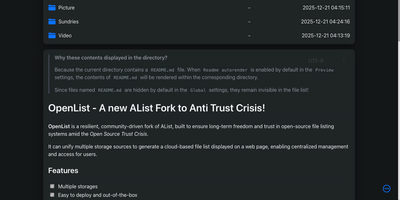
OpenList gathers every place your files live, local disks, S3 buckets, OneDrive, Google Drive, Dropbox, NAS shares, and forty-odd other services, into one browsable file list behind a single login. Mount each storage at its own path and the whole collection behaves like one tidy drive: documents open in the browser, whether PDF, Markdown, source code, or Office files, images get a gallery mode, and videos and audio play in place with subtitle and lyric support. Everyday file work happens in the same window: upload, delete, rename, move, and copy, including copying directly between two storages when you are migrating off a cloud plan. Offline download tasks let the server fetch links for you in the background, and multi-threaded acceleration squeezes speed out of sluggish single connections. Every folder can also be mounted as a real drive on your computer through the built-in WebDAV and FTP servers, with per-user permissions deciding who may read, upload, rename, or delete. Protected routes add passwords in front of sensitive shares, permalinks hand out direct download links, and granular user rules can hide files or open archive contents without extracting them. Running on a dedicated VPS on RepoCloud with guaranteed CPU, RAM, and SSD, full root SSH access, and a browser serial console. AGPL-3.0 licensed.

AsoBeast
AsoBeast keeps score of your app in the App Store and Google Play, so you always know which keywords you rank for, which ones moved, and what to fix next. Paste a store URL and tracking starts on import: rankings are checked daily in your home storefront and any other market you add, and every keyword is scored for popularity, difficulty, and opportunity so you can tell a winnable term from a vanity one. The dashboard leads with your keywords in the top 10, this week's movement, and an Action Center that turns the data into specific moves, like defending a keyword where two new rivals just entered the top 10, with the reason and the fix spelled out beside each item. Competitor listings are diffed over time, so a rival's new title, subtitle, version, or release notes show up as a before-and-after entry instead of a surprise. Metadata snapshots keep the raw store payload, localization and keyword field analysis shows wasted words, reviews feed the audit score, and the same data is exposed to your AI tools through the built-in MCP server. Registration closes itself once your owner account exists, and store requests run from your own server. Running on a dedicated VPS on RepoCloud with guaranteed CPU, RAM, and SSD, full root SSH access, and a browser serial console. AGPL-3.0 licensed.
Nexterm
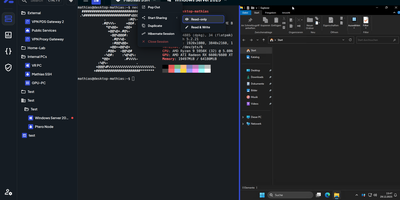
Terminals, remote desktops, and file browsers for every server you run: Nexterm opens them over SSH, VNC, RDP, Telnet, or SFTP from a self-hosted web page. Servers live in folders with tags and custom icons. Connections open as tabs or split views, keep running across browsers and devices, and can hibernate and resume later. The file manager handles SFTP and FTP: drag files in, upload whole folders, search, and edit in place with syntax highlighting. Live metrics track CPU, memory, disk, network, and processes for each host. Snippets store the commands you retype most. Scripts run whole maintenance jobs. Git repositories added as sources bring ready-made ones filtered by operating system. Organizations share servers through role-based permissions, and every action is logged. Record full terminal sessions for audits and training, or send a shared-session link so a colleague can join, read-only or writable. Authentication covers local accounts with TOTP and passkeys, OIDC providers such as Keycloak, Authentik, and Microsoft Entra ID, and LDAP or Active Directory. Saved passwords, SSH keys, and passphrases stay encrypted at rest. A Proxmox integration lists LXC containers and QEMU virtual machines and can start or stop them. An opt-in AI assistant drafts shell commands from plain-language requests. Running on a dedicated VPS on RepoCloud with guaranteed CPU, RAM, and SSD, full root SSH access, and a browser serial console. MIT licensed.
BankMCP
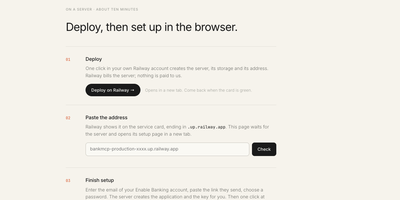
Ask your assistant what you spent on groceries last month, and let it answer from your actual bank accounts instead of a spreadsheet you never update. BankMCP is a small server you run yourself that connects your European banks to Claude, ChatGPT, Cursor, or any MCP client, so questions about balances and spending get real answers. Ask for a balance and it fetches the booked and available figures live; ask where the money went and it searches transactions across every connected account by merchant or invoice number; ask for the month and it totals money in and out while leaving transfers between your own accounts out of the picture. Background watches keep an eye out between conversations: get a webhook when a balance crosses a line, a large debit lands, a named payment arrives, or an expected payment has not shown up by its date. Ready-made prompts cover connecting a bank, building a budget, scanning savings, auditing subscriptions, and spotting unusual transactions. The server is deliberately boring about your data: it keeps consents, account labels, watches, and your login, fetches balances and transactions only when asked, and stores none of them. It is read-only by design, with no payment tools to abuse. Running on a dedicated VPS on RepoCloud with guaranteed CPU, RAM, and SSD, full root SSH access, and a browser serial console. MIT licensed.

Yarrtube
Follow the channels you actually chose, and let their newest uploads land on your own disk instead of in an algorithmic feed. Yarrtube tracks public YouTube playlists and whole channels, checks them on a schedule, and downloads fresh videos automatically the moment they appear. The built-in web player lets you watch the collected library from a desktop or a phone browser without ads interrupting. Downloads are organized into media-server friendly folders, so the same collection shows up inside Plex, Jellyfin, or Kodi next to your films and shows. For Plex homes, an optional scan trigger refreshes the library right after a download finishes, so new episodes surface without manual rescans. You control download quality per source and can cap how many videos each channel keeps, which protects limited disk space from runaway back catalogs. Grouping sources into categories and smart playlists keeps a growing archive browsable instead of turning into one long dump. Everything runs from one Docker container with two persistent mounts, one for its small database and one for the video files. A free YouTube Data API v3 key powers the new-upload checks, so setup takes minutes. Running on a dedicated VPS on RepoCloud with guaranteed CPU, RAM, and SSD, full root SSH access, and a browser serial console. MIT licensed.
Kiwix Serve
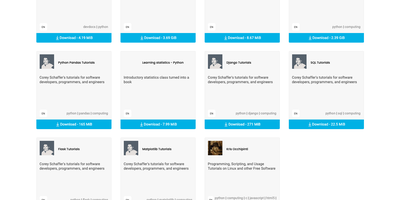
Websites such as Wikipedia, Project Gutenberg, and Stack Overflow pack into single ZIM files, and Kiwix Serve publishes a folder of them as a searchable library that opens in any browser, with no connection to the originals. Point it at individual files, a directory, or a library file, and visitors get a welcome page where they filter books by language, category, or words in the title and description. Each book opens in a built-in viewer without downloading the archive, with toolbar buttons for the library, a random article, and in-book search. Title suggestions appear as you type, and full-text search returns highlighted snippets from indexed books, across several at once when they share a language. OPDS catalogs let reader apps browse and fetch the collection, and the library reloads automatically when its file changes. Admins can swap in a custom welcome page, publish under a URL prefix, hide the library button or search box, block links that leave the archive, and cap connections per visitor. Interface translations cover dozens of languages. Universities, community networks, and home labs get a reference shelf that stays available when the original sites are slow, blocked, or gone, with developer documentation and Q&A always within reach. Running on a dedicated VPS on RepoCloud with guaranteed CPU, RAM, and SSD, full root SSH access, and a browser serial console. GPL-3.0 licensed.
Mailcow
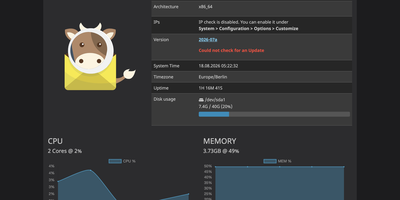
With over 13,000 GitHub stars and active monthly releases, Mailcow delivers a production-ready mail server infrastructure through Docker Compose orchestration of twelve integrated containers. The stack pairs Postfix as the MTA handling SMTP traffic with Dovecot for IMAP and POP3 retrieval featuring the Flatcurve full-text search engine, while Rspamd provides machine-learning-powered spam filtering with Bayesian classification, DKIM signing, and ARC support. ClamAV scans attachments for malware including Office document macro analysis via Olefy, and SOGo serves as a responsive webmail client with CalDAV, CardDAV, and Microsoft ActiveSync synchronization. The admin panel manages multiple domains, per-user spam score thresholds, quarantine review, black and whitelists, temporary spam aliases, mailbox quotas, and TLS enforcement policies for both inbound and outbound messages. Security features include two-factor authentication via TOTP, WebAuthn, and Yubikey OTP, a Fail2ban-like Netfilter integration for brute-force protection, and automatic SPF, DKIM, and DMARC configuration. The ACME container handles Let's Encrypt certificate generation with DNS-01 challenge support, while Postfix TLS-Pol provides MTA-STS and DANE/TLSA resolution for encrypted transport. Built-in imapsync enables periodic migration from remote mailboxes, and the REST API allows programmatic management of all server resources. MariaDB stores user data, Redis caches configuration and sessions, and Unbound provides local DNSSEC-validating DNS resolution. Running on a dedicated VPS on RepoCloud with guaranteed CPU, RAM, and SSD, full root SSH access, and a browser serial console. GPL-3.0 licensed.

Peach
Peach is a self-hosted video library manager that scrapes rich metadata for your own collection and serves it through a polished web player you can open on any device. Point it at local drives, SMB shares, mounted cloud storage, or a PikPak library and it scans everything into one browsable catalog without moving or modifying your files. The scraper recognizes video codes, reads existing NFO files, and fills in titles, performers, studios, and cover art from multiple sources while always preserving corrections you make by hand. Playback happens right in the browser with subtitle support, variable speed, rotation, resume points, and timeline previews you can scrub through before committing to a scene. A follow system tracks performers and creators so new releases surface automatically, and the discovery views plus a want list help you decide what to add next. When something is missing, search by video code or drop in a magnet link and completed downloads are filed into the library on their own. Tagging, duplicate detection, and multi-version grouping keep large collections tidy, while the task center lets you pause, resume, or cancel scans and downloads and watch their resource use as they run. Running on a dedicated VPS on RepoCloud with guaranteed CPU, RAM, and SSD, full root SSH access, and a browser serial console. AGPL-3.0-or-later licensed.
Stalwart Mail
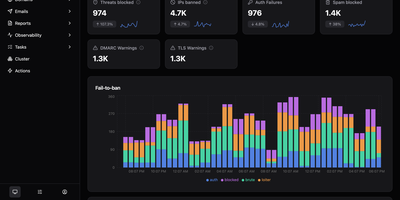
Stalwart replaces the traditional Postfix + Dovecot + SpamAssassin + calendar-server stack with one Rust binary that speaks every standard mail and collaboration protocol natively. JMAP, IMAP4rev2, POP3, SMTP, CalDAV, CardDAV, and WebDAV all run inside the same process — no glue scripts, no sidecar daemons, no version conflicts between components. The pluggable storage architecture lets operators choose RocksDB for single-node deployments, FoundationDB for distributed clusters, PostgreSQL, MySQL/MariaDB, or SQLite for the data store, S3/MinIO/Azure Blob for message blobs, and Elasticsearch or Meilisearch for full-text search, with Redis or the internal engine backing rate limiters and session state. Security features include S/MIME and OpenPGP encryption at rest, automated DKIM key generation with DNS publication, DANE and MTA-STS transport security, automatic ACME TLS provisioning, granular ACLs, rate limiting, and IP banning. The browser-based admin console manages accounts, domains, groups, mailing lists, SMTP queues, DMARC/TLS-RPT/ARF reports, and every configuration object without touching a config file, while the self-service portal at /account gives end users password reset and encryption key management. Multi-tenant support with per-tenant quotas enables hosting-platform deployments, and coordinator-less clustering via Zenoh or NATS scales horizontally by adding nodes. Deploy via Docker or the standalone binary. Running on a dedicated VPS on RepoCloud with guaranteed CPU, RAM, and SSD, full root SSH access, and a browser serial console. AGPL v3 licensed.

Suwayomi
Manga collections tend to get trapped on a single phone; Suwayomi moves the library, downloads, and reading progress onto a server you run, so every browser and device sees the same shelf. In the browser, a built-in reader handles single page, double page, continuous vertical, continuous horizontal, and webtoon layouts, adding image filters, custom keybinds, auto scrolling, and separate desktop and mobile views. Content comes from Mihon (Tachiyomi) extensions, which can be searched, browsed, and sorted into categories, with custom extension stores loaded from JSON or Protobuf indexes. Downloads save chapters as CBZ archives for offline reading, and the server checks the library for new chapters every 12 hours by default, fetching them automatically if you allow it. Progress follows you through MyAnimeList, AniList, and MangaUpdates, a Suwayomi extension and tracker for Mihon, SyncYomi servers, and KOReader. E-reader apps connect over OPDS feeds, scheduled Mihon-compatible backups protect the library, and FlareSolverr or Byparr support handles Cloudflare-protected sources. Public instances can be locked down with basic authentication, a simple login page, or JWT-based UI login, and a PostgreSQL backend, still in beta, can replace the default file store. Running on a dedicated VPS on RepoCloud with guaranteed CPU, RAM, and SSD, full root SSH access, and a browser serial console. MPL-2.0 licensed.