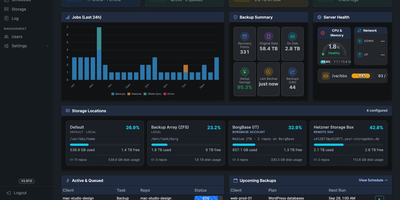
Borg Backup Server
Every connection starts at the endpoint, never at the server, so Borg Backup Server can back up Linux, Mac, and Windows machines behind NAT and firewalls without opening a single inbound port. A lightweight agent on each machine polls for tasks over HTTPS, pushes deduplicated archives over SSH, and reports live progress. Append-only SSH access means an endpoint can add and restore archives but never prune or delete them. The dashboard shows backup charts, server stats, and active jobs at a glance. Plans run from hourly to monthly, several per client, built from reusable directory templates for common server roles, with per-plan retention from hourly to yearly. Lost a file? Browse the archive tree in your browser, tick what you need, and restore it to the client or download a .tar.gz. MySQL and PostgreSQL dumps run before each backup and restore as a copy or a replacement. Repositories can live on the server, on BorgBase, Hetzner, or rsync.net, and mirror to S3-compatible storage such as AWS, Wasabi, or Backblaze B2. Apprise alerts reach more than 100 services, and a nightly report lands in your inbox. Two-factor login and role-based access guard the console. Upgrades roll out to the server and every agent together, and the server backs itself up daily. Running on a dedicated VPS on RepoCloud with guaranteed CPU, RAM, and SSD, full root SSH access, and a browser serial console. MIT licensed.
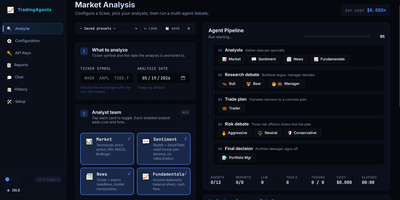
TradingAgents GUI
Built atop the TauricResearch TradingAgents framework with nearly 100,000 GitHub stars, TradingAgents GUI transforms a CLI-only multi-agent LLM stock analysis pipeline into a polished web application accessible at localhost:5000. The system deploys twelve specialized AI agents — fundamental analysts, sentiment experts, technical analysts, bull and bear researchers, a trader, risk management team, and portfolio manager — who collaboratively debate market conditions through structured LangGraph workflows before producing a final BUY, SELL, or HOLD recommendation. The interface supports ten LLM providers including OpenAI, Anthropic, Google, OpenRouter, DeepSeek, Ollama, xAI, Qwen, GLM, and MiniMax, with a first-run wizard that auto-detects configured API keys and tests connections. A live pipeline visualization shows each agent's status with real-time progress bars, while the tabbed output area separates Live Feed, Reports preview, and Tool calls into dedicated panes. The three-pane Reports tab provides searchable indexing, table-of-contents navigation, and export to Markdown, HTML, or PDF formats. Report length control across Concise, Standard, and Comprehensive modes saves up to 50% on token costs. Multi-session chat allows pinning past reports as grounding context with live token counting and context-window warnings. Three built-in themes — Terminal, Modern, and Bloomberg — persist per browser. Docker Compose deployment maps port 5000 with persistent report storage. Running on a dedicated VPS on RepoCloud with guaranteed CPU, RAM, and SSD, full root SSH access, and a browser serial console. Apache 2.0 licensed.
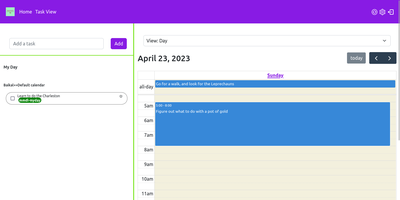
Manage My Damn Life
Manage My Damn Life is a personal productivity platform and CalDAV task manager that gives individuals and teams a full-featured web workspace for coordinating todos, calendar agendas, and project schedules without relying on proprietary productivity software. Users can connect multiple CalDAV server backends including Nextcloud, Radicale, and Baikal to synchronize tasks, events, and subtasks across their self-hosted infrastructure. The interface offers multiple interactive perspectives, letting planners switch between nested task checklists, full monthly calendar grids, and dynamic Gantt chart roadmaps with customizable timeline scales. Keyboard-driven operators can rapidly log action items via intuitive Quick Add syntax that parses due dates, priority tiers, and category labels from inline text triggers. A versatile filter manager allows users to save custom query views matching due dates, completion statuses, parent task hierarchies, and color-coded labels. Team members can establish reusable task templates for recurring administrative workflows, assign multi-level checklist items, and manage individual calendar visibility across shared workspaces. System administrators can configure user authentication through native accounts or integrate enterprise Single Sign-On using OpenID Connect providers like Keycloak, Authentik, and Google. Client-side state caching accelerates navigation while background sync preserves CalDAV compliance. Running on a dedicated VPS on RepoCloud with guaranteed CPU, RAM, and SSD, full root SSH access, and a browser serial console. GPL v3 licensed.

OpenReader
With OpenReader, any EPUB, PDF, Word document, Markdown file, or plain text book transforms into an interactive reading workspace paired with natural text-to-speech playback and multi-chapter audiobook export. Documents render natively in their original page layout rather than flattening into plain text, using layout-aware block detection and cross-page stitching so multi-column academic papers, technical manuals, and textbooks flow in the right reading order while skipping headers and footnotes. As narration plays, word-level forced alignment highlights each spoken word directly on the page in real time, and progressive background generation starts audio playback on the first segment while synthesizing upcoming pages ahead of your cursor. Readers can connect local speech engines such as Kokoro, KittenTTS, and Orpheus or cloud voice providers, select language-aware voices for multilingual books, adjust playback speed, and switch among thirteen light and dark reading themes. Cached audio segments persist across seeks and browser reloads, allowing the background worker to assemble complete M4B or MP3 audiobooks for offline listening on mobile devices while syncing reading progress, queues, and library imports across sessions. Running on a dedicated VPS on RepoCloud with guaranteed CPU, RAM, and SSD, full root SSH access, and a browser serial console. MIT licensed.
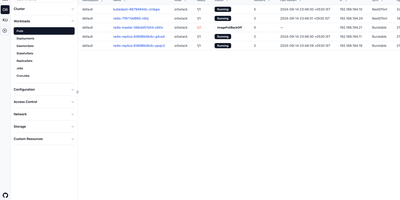
Kubewall
One binary is all that stands between you and every Kubernetes cluster you own: Kubewall opens a realtime web dashboard over all of them, with no agents to install and nothing phoning home. Switch between clusters from the sidebar and browse workloads, networking, storage, configuration, and access control in tables that update live as pods start, fail, and reschedule. Open any resource to inspect its overview, edit its manifest in the built-in YAML editor with validation, watch its events, or stream logs aggregated across pods and containers with search and tail controls. A command palette jumps straight to any resource type, while faceted filters and global search cut through thousands of objects by name, namespace, label, or image. Scale deployments, restart pods, trigger rollout restarts, and apply manifests with a click, or forward a cluster service to your local machine without memorising kubectl incantations. An integrated AI assistant, connected to OpenAI, Claude, Gemini, DeepSeek, OpenRouter, Ollama, or a local model, helps troubleshoot failures and review configurations right beside the resource it concerns. Running on a dedicated VPS on RepoCloud with guaranteed CPU, RAM, and SSD, full root SSH access, and a browser serial console. Apache-2.0 licensed.
Concourse
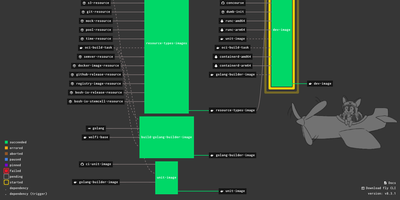
When a commit lands, a timer fires, or a pull request opens, Concourse runs the matching jobs in fresh containers and draws the entire CI/CD pipeline as a live graph you can read at a glance. Pipelines are plain YAML files that tie resources such as git repositories, registries, and buckets to jobs made of get, put, and task steps, so the same file behaves the same on every installation. Resources are checked continuously for new versions, webhooks can request an immediate check, and a version can be pinned when something needs to stay put. The dashboard lists every pipeline by team with status colors, a filter box, favorites, and a high-density view, while build pages stream colored logs and let you rerun a build with the exact same inputs. The fly command line sets pipelines, runs one-off tasks against local files from your laptop, and opens a shell inside the container of a failed step. A set_pipeline step lets pipelines configure other pipelines, and instance vars create a family of related pipelines, such as one per pull request. Teams keep projects separate and can be tied to a GitHub organization, credentials arrive at run time from Vault, CredHub, AWS, or Kubernetes, and policy rules can block disallowed images. Running on a dedicated VPS on RepoCloud with guaranteed CPU, RAM, and SSD, full root SSH access, and a browser serial console. Apache-2.0 licensed.
Farfalle
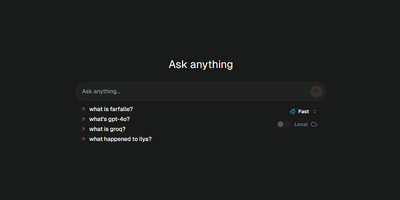
Live web search plus an LLM of your choice: Farfalle is an open-source, self-hosted answer engine in the Perplexity mold. Queries route through one of several search providers - self-hosted SearXNG for a fully independent stack, or Tavily, Serper, and Bing APIs - and the model composes a cited answer from the retrieved results. Model flexibility is the core design: run llama3, mistral, gemma, or phi3 locally through Ollama for zero per-query cost and full privacy, use cloud models like GPT-4o or Groq-hosted Llama 3 for speed, or route to any provider via LiteLLM. An Expert Search mode uses an agent that plans a multi-step search strategy and executes it for harder questions, and chat history keeps prior research sessions available. The stack is a Next.js and shadcn/ui frontend over a FastAPI backend with Redis rate limiting, shipped as a pre-built Docker image. A browser search-engine entry pointing at your instance makes it the default search from the address bar. Paired with SearXNG and Ollama, the whole pipeline runs with no external API at all.
Subarr
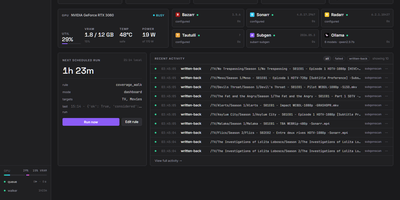
Subarr is the coordination, measurement, and quality layer for Whisper subtitle generation, sitting between Bazarr, Sonarr, Radarr, and subgen to decide what gets transcribed, in what order, and whether the result is any good. Its Coverage walk scans your whole library and scores every subtitle gap with a reason: no track, embedded-only, Bazarr-wanted, audio mislabeled, or low quality. Queue a file, a folder, or an entire series from the Library tab and watch it move through probing, transcribing, and write-back on the dashboard. The Review queue plays you the actual dialogue, picked out by voice-activity detection, so you can verify a subtitle really matches the audio language before it lands. It flags files whose default audio track is not the original language and swaps tracks in place, heading off the double-translation trap. A provider leaderboard records which subtitle sources actually deliver for your library, and the Tuning Lab lets you tune Whisper recipes against your own media. Rules and scheduled walks keep the work flowing, with Tautulli now-playing signals boosting whatever you are about to watch. Finished subtitles are written next to your media, and your Plex or Jellyfin library refreshes the moment one lands. Running on a dedicated VPS on RepoCloud with guaranteed CPU, RAM, and SSD, full root SSH access, and a browser serial console. MIT licensed.
UseAgent
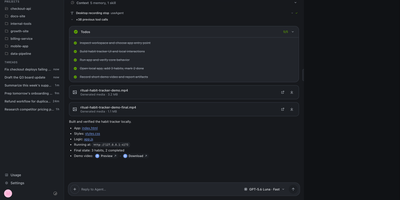
Hand a task to an AI teammate the way you would hand it to a person: describe the work, then follow along and step in when it matters. UseAgent runs Claude Code, Codex, OpenCode, and Pi inside isolated Linux workspaces, each with your repositories, a terminal, a real browser, and a desktop you can open and take over. Start work from the web app, by mentioning an agent in Slack, or through the API, and get pull requests, documents, spreadsheets, presentations, and research back as usable files. Four engines share one thread and one event format, so you can compare how Claude Code and Codex each handled the same bug, then switch engines on the next reply without losing history, files, or memory. Risky operations pause at approval gates, and a decision resumes the run with a one-shot, argument-bound capability instead of blanket trust. Every step, tool call, and approval is stored as an append-only event log in your Postgres, replayable after the fact and durable across restarts mid-task. Teach the workspace your procedures by importing versioned skills from GitHub and pinning playbooks to tasks, while knowledge pages and optional team memory stay beside the work, inspectable and correctable. Recurring tasks run on schedules with full history. Provider keys stay on your server and never enter an agent sandbox. Running on a dedicated VPS on RepoCloud with guaranteed CPU, RAM, and SSD, full root SSH access, and a browser serial console. AGPL-3.0 licensed.
DockFlare
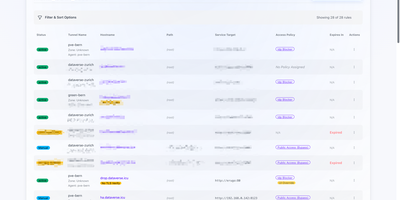
Combining Docker container labels with a live web control plane, DockFlare automates Cloudflare Tunnel ingress routing, multi-zone DNS records, and Zero Trust Access policies across self-hosted infrastructure. DevOps engineers and homelab operators can attach simple container labels to expose HTTP, HTTPS, TCP, SSH, and RDP services publicly in seconds without clicking through external cloud dashboards. For non-containerized workloads such as bare-metal hypervisors or network appliances, administrators can define manual ingress rules, path-based routes, custom TLS SNI headers, and origin certificate bypass flags directly in the web interface. Security teams use reusable Access Groups and wildcard zone policies to enforce Google, GitHub, Azure AD, or custom OIDC authentication across every subdomain from a single policy definition. Distributed deployments connect lightweight remote agents back to the primary controller using Zero Trust service tokens so multi-host clusters share one unified routing view. When containers stop or restart, configurable grace-period timers prevent accidental route churn before cleaning up stale DNS entries, while encrypted state backups protect your entire ingress configuration. Running on a dedicated VPS on RepoCloud with guaranteed CPU, RAM, and SSD, full root SSH access, and a browser serial console. GPL-3.0 licensed.
docat
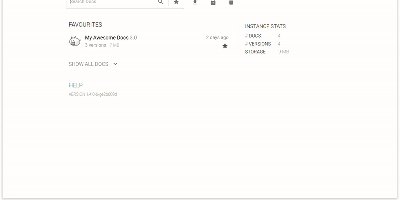
Hosting finished documentation for many projects at once, Docat leaves every uploaded version online for the readers still on version 2. Zip the static HTML that MkDocs, Sphinx, or mdBook produced. Send it to a project and version with curl or the docatl command line client. Tag the newest build as latest, and links get a stable address. Readers land on a home page that opens on starred favourites. A search box narrows the list, and its queries can be shared as links. Instance statistics report documents, versions, and storage. Inside any docs page, a version dropdown with a latest label moves between releases. Uploads are open at first. Claim a project and it returns a token that must accompany every later version upload or deletion. The same token hides versions from the dropdown and from search, and each project can carry its own icon. Operators can mount a small config file for custom header and footer HTML, raise the 100 MB default archive limit with an environment variable, and put nginx basic authentication in front of the write endpoints. Swagger UI and ReDoc pages at /api/docs and /api/redoc document the HTTP API for pipeline authors. Running on a dedicated VPS on RepoCloud with guaranteed CPU, RAM, and SSD, full root SSH access, and a browser serial console. MIT licensed.
SkySend
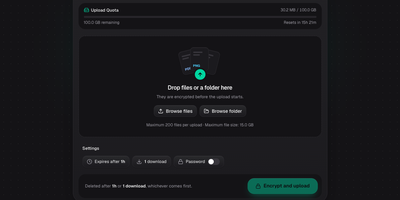
Only the person holding the link can open what you share with SkySend, a self-hosted file and note sharing service that encrypts everything in the browser before it leaves your device. Sending a contract? Drop in the file, several files, or a whole folder, and share the link. Need documents from a client? Send an upload link instead, and whatever comes back is encrypted for you alone. Handing over a password or an SSH key? Write it into a note that burns after reading. Notes can mix text, Markdown, generated passwords, and highlighted code in a single page. Every share can expire by time, stop after a set number of downloads or views, and carry an optional password as a second lock. The command-line client uploads, downloads, and reads notes with the same encryption, and its full-screen mode shows each link as a QR code. No accounts are needed: My Links keeps your shares in the browser, and optional OIDC sign-in limits who may create them. Encrypted uploads sit on local disk or any S3-compatible bucket, and the interface offers 13 languages and three themes. Running on a dedicated VPS on RepoCloud with guaranteed CPU, RAM, and SSD, full root SSH access, and a browser serial console. AGPL-3.0 licensed.
OpsiMate
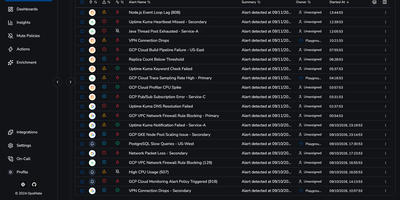
OpsiMate gives on-call teams one queue for alerts that would otherwise arrive in five different dashboards, each demanding attention in its own tab. Connect Grafana, Datadog, Zabbix, Uptime Kuma, Google Cloud, or any custom webhook source and watch incoming alerts land in one table with their source, service, severity, tags, and status attached. Filter the noise down to the team or service you own, group related alerts so one incident does not look like forty separate emergencies, and use mute policies when a known problem should stop paging people. Acknowledge work with one click, assign ownership so nobody wonders who is responding, resolve alerts from the same screen, and follow deep links back into Grafana or Zabbix when you need the original chart or trigger. Let supported integrations auto-resolve alerts when the underlying monitor recovers, and use root-cause notes and insights to keep the next responder from starting at zero. Discover services running in Docker, Kubernetes, and Linux virtual machines so the alert queue stays connected to the infrastructure behind it. Running on a dedicated VPS on RepoCloud with guaranteed CPU, RAM, and SSD, full root SSH access, and a browser serial console. AGPL-3.0 licensed.

Nowen Video
Nowen Video turns the hard drive of films and series sitting on your NAS into a streaming service your family actually wants to open, posters, seasons, and all. Point it at your media folders and it scans the usual formats, reads streams with FFprobe, and scrapes rich metadata from TMDb, Douban, TheTVDB, Bangumi, and Fanart.tv, recognizing movie, season, and episode naming as it goes. NFO files and external subtitles are honored, filesystem watching keeps the library current, and collections plus episode navigation make a big archive feel curated rather than dumped. Pressing play is where the engineering shows: a server-side planner decides per client whether to direct play, remux, or transcode to HLS on demand, with automatic fallback when the first choice fails. Hardware acceleration through the GPU keeps transcoding cheap, subtitle and speed controls ride along in the player, and a local analysis pass can surface highlight clips from your own footage. Every family member gets favorites, watch history, and continue-watching progress under their own account, while library permissions decide who sees what. An Emby-compatible API even lets clients like Infuse connect as if it were an Emby server. Running on a dedicated VPS on RepoCloud with guaranteed CPU, RAM, and SSD, full root SSH access, and a browser serial console. GPL-3.0 licensed.
Medama
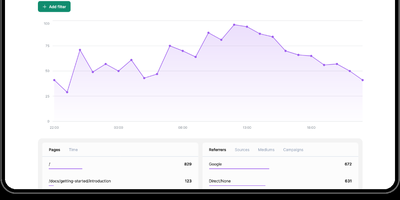
Track website traffic and conversion funnels with sub-second precision while guaranteeing visitors total anonymity with Medama, a privacy-first web analytics platform operating without cookies, IP storage, or consent banners. Site owners embed a sub-kilobyte tracking script into web headers to record page views, session duration, referrers, screen resolutions, browser user agents, and geographic countries anonymously. Built-in caching header mechanisms determine unique daily visitors without generating persistent hashes or storing cross-site identifiers that violate privacy regulations. The web dashboard visualizes hourly traffic trends with interactive area charts and provides multi-dimensional data tables breaking down top-performing pages, search engine referrers, operating systems, and campaign UTM parameters. Developers can instrument custom click events and page attributes using simple HTML data attributes to measure conversions, document downloads, button interactions, and user subscription states. Administrators manage multiple websites from a single interface, configure curated anti-spam blocklists using Firehol and Tor exit node feeds, and monitor server CPU, memory, and disk usage in real time. Full OpenAPI specification endpoints allow teams to export analytics data directly into internal business intelligence pipelines and custom executive dashboards. Running on a dedicated VPS on RepoCloud with guaranteed CPU, RAM, and SSD, full root SSH access, and a browser serial console. Apache-2.0 licensed.
maddy
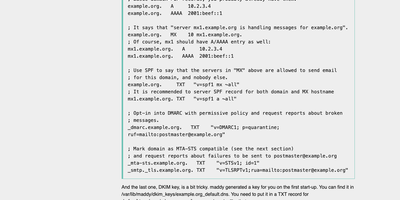
Running a proper mail server used to mean stitching together half a dozen daemons; maddy folds the whole stack into one binary with one configuration file. It receives mail as your MX, sends as your MTA, stores messages for IMAP clients, and signs and verifies with DKIM, SPF, DMARC, DANE, and MTA-STS so other servers actually trust what you send. The design is composable: checks, modifiers, tables, and delivery targets snap together in the config, so spam scoring, address rewriting, and routing rules read like a pipeline instead of a pile of interlocking config files. Outbound mail queues with retries and backoff, inbound delivery lands in IMAP storage backed by SQLite or PostgreSQL, and a built-in ACME client keeps TLS certificates renewed, including DNS-01 providers. Milter support lets existing filters join the pipeline, authentication spans SASL mechanisms and Dovecot delegation, and Prometheus metrics watch queue length and delivery health from your usual dashboards. Running on a dedicated VPS on RepoCloud with guaranteed CPU, RAM, and SSD, full root SSH access, and a browser serial console. GPL-3.0 licensed.

Upvote RSS
The antidote to doomscrolling: Upvote RSS turns Reddit, Hacker News, Lemmy, Lobsters, PieFed, Mbin, and trending GitHub repositories into calm, filtered RSS feeds. The MIT-licensed PHP app's killer feature is intelligent filtering: beyond simple score thresholds, the "posts per day" filter analyzes a community's recent history and computes the score cutoff that yields your target volume - say, exactly three r/technology posts daily - while a percentage-based threshold mode stays consistent as communities grow. Feeds are rich, not bare links: parsed full-article content via Readability (with optional Readability.js, Mercury, or Browserless for JavaScript-heavy pages), embedded videos and image galleries, top-voted comments with pinned-moderator filtering, scores, reading-time estimates, and optional AI summaries through Ollama, OpenAI, Gemini, Anthropic, Mistral, DeepSeek, or any OpenAI-compatible endpoint - with automatic provider fallback. A web UI builds the feed URL interactively with live preview; paste the result into any RSS reader. Reddit support includes custom domains like old.reddit.com plus NSFW filtering and blurring. Caching via filesystem, Redis, or APCu keeps repeated fetches cheap and avoids re-running paid summarizations.
Motor Admin
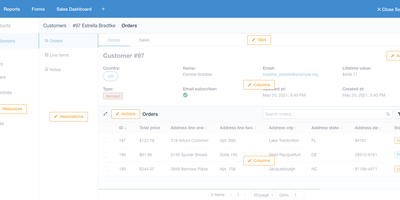
Stop building internal tools and ship your actual product - Motor Admin exists for exactly that. Point this Ruby/Vue application at a PostgreSQL, MySQL, MariaDB, or SQL Server database and it generates a complete CRUD admin panel from your schema in under a minute - search, filters, create, update, delete, all through a polished UI, with every customization done through in-app settings rather than a DSL or boilerplate code. What elevates it beyond CRUD generators is the business-intelligence half: write SQL queries (with variables) and render results as tables, numbers, line/bar/ pie charts, funnels, or markdown; organize reports into shared dashboards; and attach queries and dashboards directly to resource pages as tabs, so an order record shows its revenue history in place. Operations beyond CRUD are covered by custom actions and a WYSIWYG forms builder that posts to your existing REST or GraphQL APIs - send a refund, trigger an email, whatever your backend exposes. Email alerts deliver scheduled reports, Slack sends personalized report alerts, and intelligence search spans all resources. Governance is included: role-based permissions with row- and column-level control (CanCanCan), an audit log of admin activity, multiple database connections, and configuration sync between staging and production. Mobile-optimized, AGPL-licensed, also available as a Rails engine.