Dobase
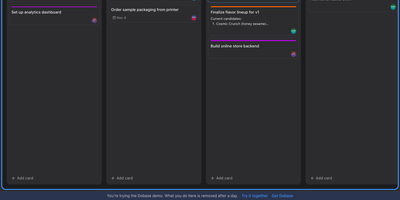
Dobase replaces the scattered pile of team subscriptions with one self-hosted workspace where mail, kanban boards, documents, chat, to-do lists, files, a calendar, and video rooms live side by side. Install only the tools your team needs, and share each one with exactly the collaborators you choose; a board for the whole company and a private todo list can sit in the same window. Several people can type in the same document at once, watching each other's colored cursors while the text merges cleanly, and presence faces in the sidebar show who is inside every tool right now. Open tools arrange themselves as tiles in a wide window, so chat can sit next to the board it discusses and the calendar under the mail you are answering. Pressing Cmd+K searches cards, todos, documents, files, chat, events, and mail in one motion, and nearly everything also works from the keyboard alone. Mail threads conversations and lets you accept calendar invites from the message, files get public links guarded by a password and an expiry, and the calendar syncs with CalDAV services or runs on its own. Video rooms with screen sharing join the same workspace, mentions and notifications follow you, and an email digest catches up anyone who was away. Running on a dedicated VPS on RepoCloud with guaranteed CPU, RAM, and SSD, full root SSH access, and a browser serial console. MIT licensed.
Zipline
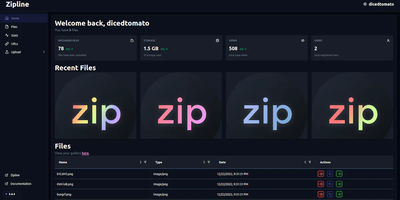
ShareX and file uploads, next generation: Zipline is a Node.js/React/PostgreSQL server that turns screenshot sharing and file hosting into something you run yourself instead of renting from Imgur or a paid image host. The core workflow is built around ShareX: generate an .sxcu config from your account settings, import it, and every screenshot or clipboard capture uploads to your domain with a short link copied automatically. Uploads accept any file type, organized with folders and tags, with token-protected uploading, optional password protection, view-limited auto-deletion, image compression, metadata stripping, automatic video thumbnails, and chunked/partial uploads for large files. File URLs come in configurable formats - UUIDs, dates, random alphanumerics, original names, even zero-width spaces. A built-in URL shortener adds vanity slugs, passwords, view caps, and custom domains. Discord embeds are first-class: customize OG metadata titles, descriptions, and colors so links unfurl exactly how you want, and fire fully customizable Discord or HTTP webhooks on each upload. Authentication is serious: OAuth2 (Discord, GitHub, Google, OIDC), TOTP two-factor, and passkeys, with invite-based registration and per-user quotas for shared instances. Storage targets local disk or any S3-compatible backend, a full REST API automates everything, and custom themes plus a PWA round out the experience.
Filestash
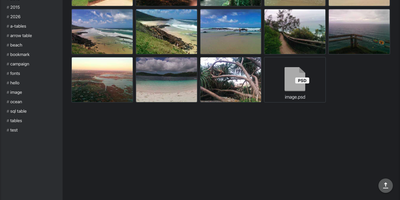
Filestash puts a Dropbox-style web interface in front of the SFTP servers, S3 buckets, SMB shares, and WebDAV storage you already run, so no file has to move. Administrators enable each connector, including FTP, NFS, Git, Dropbox, Google Drive, Storj, IPFS, and Backblaze B2, from one admin console. Colleagues browse, rename, move, and upload in a single folder view, with resumable uploads for big transfers. Thumbnails cover JPEG, PNG, WebP, TIFF, HEIF, and RAW photos. Images open with an EXIF info panel, and PDFs, audio, video, and EPUB ebooks open right in the browser. A CodeMirror editor handles text and code, and HLS transcoding streams video on demand. Outside guests get a shared link instead of credentials, with an optional password, an expiry date, and read, write, or upload-only rights. Limit a link to one email address or a whole domain, or mount it as a network drive. A workflow engine chains emails and HTTP calls after file events, webhooks, or schedules. Flip one admin setting and Claude, ChatGPT, and Mistral Le Chat can use the connected storage as MCP tools. Downloadable file apps add Office documents, 3D models, and GIS maps. Runtime plugins are zip files dropped into the plugins folder. Running on a dedicated VPS on RepoCloud with guaranteed CPU, RAM, and SSD, full root SSH access, and a browser serial console. AGPL-3.0 licensed.
Filex
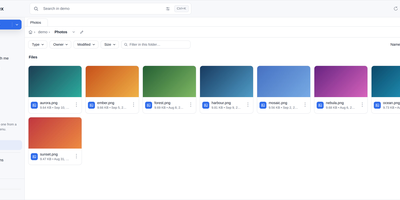
Your files already live in five places; filex puts them in one tree and serves that tree back out through almost any protocol. Mount local disks, S3 buckets, SFTP servers, WebDAV shares, FTP sites, and SMB network drives side by side, then copy in one storage and paste into another without thinking about where anything physically sits. The same tree is reachable as S3, SFTP, FTPS, NFS, and WebDAV, so rclone, restic, the AWS CLI, WinSCP, or FileZilla all work against it with the same per-user and per-folder permissions as the web interface. Sharing leaves the server under your control: public links carry a PIN, an expiry, and a download limit, and file-request links let people upload into a folder without seeing its contents. Anything deleted stays recoverable inside a retention window, overwritten files keep version snapshots, and encrypted folders are sealed in the browser so the server never receives a key. People sign in with OIDC single sign-on, LDAP or Active Directory, or the host machine's own accounts, with roles, groups, and tenants plus folder-level exceptions. A desktop app keeps chosen folders in sync within about a second, the file manager embeds into other products as a web component, and an MCP server plus REST API let agents work the same tree. It runs from one static binary or container on port 5212. Running on a dedicated VPS on RepoCloud with guaranteed CPU, RAM, and SSD, full root SSH access, and a browser serial console. MIT licensed.
OpenList
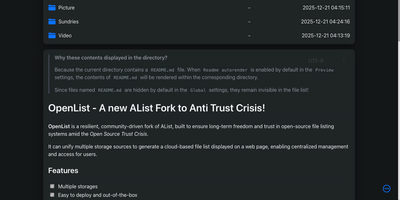
OpenList gathers every place your files live, local disks, S3 buckets, OneDrive, Google Drive, Dropbox, NAS shares, and forty-odd other services, into one browsable file list behind a single login. Mount each storage at its own path and the whole collection behaves like one tidy drive: documents open in the browser, whether PDF, Markdown, source code, or Office files, images get a gallery mode, and videos and audio play in place with subtitle and lyric support. Everyday file work happens in the same window: upload, delete, rename, move, and copy, including copying directly between two storages when you are migrating off a cloud plan. Offline download tasks let the server fetch links for you in the background, and multi-threaded acceleration squeezes speed out of sluggish single connections. Every folder can also be mounted as a real drive on your computer through the built-in WebDAV and FTP servers, with per-user permissions deciding who may read, upload, rename, or delete. Protected routes add passwords in front of sensitive shares, permalinks hand out direct download links, and granular user rules can hide files or open archive contents without extracting them. Running on a dedicated VPS on RepoCloud with guaranteed CPU, RAM, and SSD, full root SSH access, and a browser serial console. AGPL-3.0 licensed.
zrok
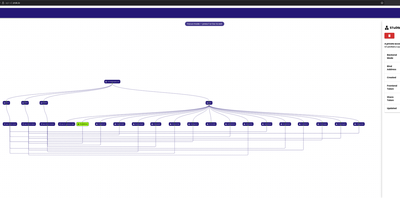
zrok puts services that live behind NAT and firewalls onto the public internet with a shareable URL, without opening a single inbound port. The machine being shared dials out to an OpenZiti overlay network, so a web app on your desk, a Raspberry Pi at home, or a staging box inside a corporate network becomes reachable through your instance while its firewall stays closed. One command shares an HTTP service publicly; add a name from one of your namespaces and the URL stays stable even when you move the backend to a different machine, and an ephemeral name can be promoted to a reserved one when a quick demo turns into a keeper. Private shares skip the public internet entirely and reach only the users you grant, including raw TCP and UDP services, while web and drive backend modes publish static sites or whole folders, with OAuth, password auth, and an interstitial warning page available on public shares. The long-running agent keeps every share and access under one process, restarts the named ones after a reboot, and offers a localhost console for point-and-click sharing; the account-wide web console maps your environments, shares, and accesses as a navigable graph or a sortable table with live activity. Operators get invite-based accounts, InfluxDB-backed usage metrics, and configurable limits that warn or cut off accounts that exceed their quotas. Running on a dedicated VPS on RepoCloud with guaranteed CPU, RAM, and SSD, full root SSH access, and a browser serial console. Apache-2.0 licensed.
Mikochi
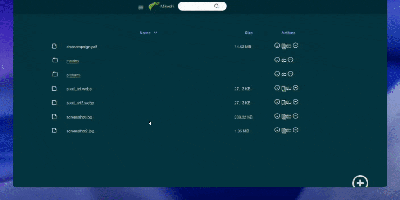
Point a browser at your server's folders and skip the FTP clients, the SSH tunnels, and the heavyweight cloud clones: Mikochi turns any directory on your machine into a clean web file browser you can open from anywhere. You browse nested folders in a fast list view, jump to files with fuzzy search, upload new material, create folders, rename items, and delete what is no longer needed. Whole directories come down as a single tar.gz archive, which makes backups and bulk transfers painless. Media files get a smarter treatment: Mikochi generates streaming links that open directly in VLC or mpv, so a film or album stored on the server plays on your screen without downloading gigabytes first. Access stays protected behind a username and password login with JWT sessions, and you can serve everything over TLS with your own certificates or disable authentication entirely on a trusted private network. Deployment takes one Docker command with a mounted data directory, and Kubernetes users get an official Helm chart. Homelab owners point it at a NAS share, developers drop it on a build box, and anyone tired of scp commands gets a permanent window into their files. Running on a dedicated VPS on RepoCloud with guaranteed CPU, RAM, and SSD, full root SSH access, and a browser serial console. MIT licensed.
DashBeam
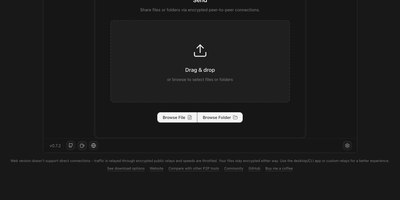
DashBeam sends files and folders of any size straight from one device to another, end to end encrypted, with no cloud account, no size limits, and nothing parked on a third party server in between. Drop in a file and share it through a short code, a link, or a QR scan; whoever receives it needs no account and can collect it in a plain browser tab with nothing installed. On the same network, nearby machines appear on their own, so pairing two devices and sending between them takes a couple of clicks instead of a cable or a memory stick. Pair a device once and it stays reachable by its identity, so your machines can exchange files from anywhere without swapping fresh tickets every time. Interrupted transfers resume where they stopped, and hopping from Wi-Fi to cellular mid-send does not drop the connection. One share can fan out to several receivers at once, and devices you mark as trusted can accept files automatically, which suits pushing builds, media libraries, or backups around a small fleet. You can preview what is arriving before downloading it, and a local history records every completed transfer. The repository also ships Docker Compose stacks for your own relay and discovery server, so even the encrypted fallback path can run entirely on machines you own. Running on a dedicated VPS on RepoCloud with guaranteed CPU, RAM, and SSD, full root SSH access, and a browser serial console. AGPL-3.0 licensed.
Drive
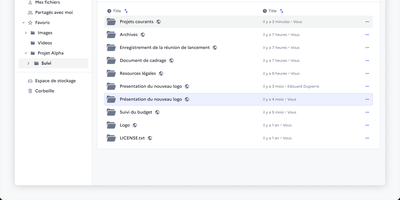
Somewhere in every organisation there is a folder called FINAL_v2 that nobody dares delete, and Drive from La Suite exists to end that. It gives teams a shared file space where uploads land in organised workspaces, versions stay findable through search, and every file or folder carries its own access list. You preview PDFs, images, audio, and video in the browser, and office documents open for editing through Collabora or OnlyOffice without downloading a thing. Sharing reaches outside the organisation too: invite external partners by link, even without an account, and revoke access the moment a project ends. Uploads pass malware scanning before they touch storage, a trash bin restores accidents, and quotas with usage metrics keep big archives honest. Administrators plug in their own OIDC identity provider, so logins follow the same single sign-on as the rest of the stack, while an embeddable file picker lets other internal apps reuse Drive as their document library. Because the data lives in your own S3-compatible storage, sovereignty requests stop being an argument with a vendor and become a setting. Running on a dedicated VPS on RepoCloud with guaranteed CPU, RAM, and SSD, full root SSH access, and a browser serial console. MIT licensed.
Pingvin Share X
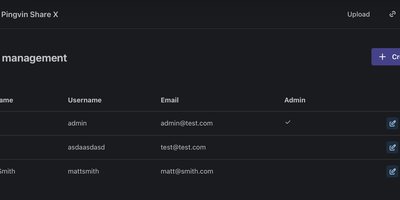
Pingvin Share X is your own WeTransfer, running on your server, with none of the transfer limits or expiring-link anxiety of the free tiers. Drop in a file of any size, get a link, and decide exactly how it behaves: an expiration date after which it vanishes, a password gate, a cap on how many visitors may open it, or all three. Email the link straight to recipients from the share dialog, and get notified when they download. Reverse shares flip the flow around: send someone a link and they upload files to you through it, which is perfect for collecting client deliverables, application documents, or the family photo archive without a single email attachment thread. Attachments can be scanned with ClamAV before anyone touches them, and storage lives on your disks or in S3-compatible buckets. Accounts connect through OIDC or LDAP single sign-on for teams, and an extensive admin panel tunes everything from password policy to upload chunk sizes. Registration rules decide whether your instance is a private family tool or an open drop point for your whole crew. Running on a dedicated VPS on RepoCloud with guaranteed CPU, RAM, and SSD, full root SSH access, and a browser serial console. BSD-2-Clause licensed.

GroupOffice
GroupOffice checks your whole company in at one address: mail, meetings, projects, invoices, and files behind a single login on your own server. The built-in mail client saves messages straight onto projects or contacts, signs and encrypts with S/MIME, and shares folders and accounts across the team. Shared calendars offer team views, bookable resources, and video meetings, while address books carry custom fields and comments so customer knowledge survives staff changes. Projects gather their tasks, files, and discussions in one place, track hours as work happens, and turn those hours and costs into invoices and reports. Support tickets arrive from your website or by email and stay organized by team, and newsletters compose campaigns from templates filled with your own data. Files co-edit in the browser through OnlyOffice or Collabora, connect to desktops over WebDAV, and sync to native phone and computer apps over open protocols. Two-factor authentication, encryption, and a module system you can extend with your own tools keep the office private and shaped to how you actually work. Running on a dedicated VPS on RepoCloud with guaranteed CPU, RAM, and SSD, full root SSH access, and a browser serial console. AGPL-3.0 licensed.
HRConvert2
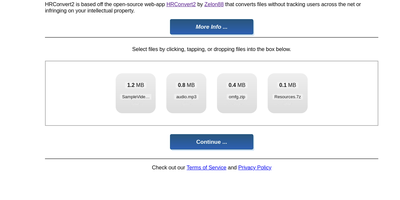
Stop pasting your files into ad-riddled online converters and handing strangers copies of your documents: HRConvert2 runs the whole conversion workshop on your own server instead. Drop a file onto the browser page and pick an output format from a catalogue of 488, covering documents, spreadsheets, presentations, ebooks, comics, images, audio, video, subtitles, and archives. Built-in OCR reads scanned PDFs and images and hands back editable text documents you can search and reuse. It converts 3D models and CAD drawings, renders OpenSCAD projects with their multi-file assemblies resolved, and can even build bootable ISO disk images for x86 and ARM machines from ordinary uploads. Live streams are captured and re-encoded straight from .m3u8 playlists, and every uploaded file can be virus-scanned with ClamAV before or after conversion. Finished files go back out through temporary share links that expire on their own, so sending a converted video to a client takes one click. Each visitor works in an isolated scratch space, files delete themselves when they age out, and nobody needs an account, ever. When traffic spikes, the server watches its own CPU and memory, throttles conversions, and spreads storage across disks so it stays upright. Three interfaces, seven color schemes, and 26 languages let each user shape the page to taste, and the whole thing runs happily on a Raspberry Pi with no database at all. Running on a dedicated VPS on RepoCloud with guaranteed CPU, RAM, and SSD, full root SSH access, and a browser serial console. GPL-3.0 licensed.
Reloops
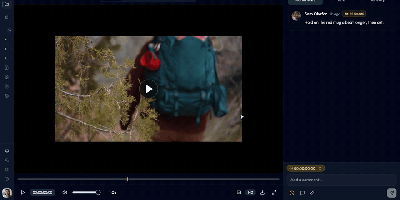
Reloops is a self-hosted creative asset workspace where teams keep every video, design, PDF, audio file, and live website in one library and collect feedback on the files themselves instead of in scattered email threads. Reviewers click anywhere on an image to pin a note to that exact spot, and on video the comments attach to the precise frame, so "fix this bit" always points at the bit in question. Every upload becomes a new version on the same asset, older cuts stay available for side-by-side comparison, and approvals are recorded on the file so nobody ships the wrong export by accident. Clients never need an account: send them a share link or a branded collection and they can watch, comment, and sign off as guests. The library searches the way people remember work, because each asset carries generated descriptions, tags, and metadata filters, so "the approved homepage with the blue button" actually finds something. Day to day, assignments and review queues keep feedback moving, while scoped API keys let agents such as Claude, OpenClaw, Zapier, and n8n upload new versions, post comments, update statuses, and manage share links inside the same workspace. Running on a dedicated VPS on RepoCloud with guaranteed CPU, RAM, and SSD, full root SSH access, and a browser serial console. AGPL-3.0 licensed.
bewCloud
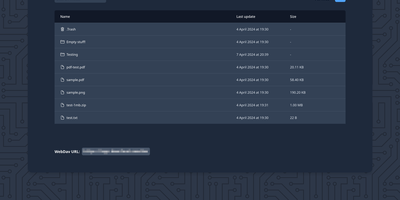
A personal cloud does not need the weight of a small enterprise suite, and bewCloud proves it by keeping files, photos, notes, contacts, and calendars in one compact service a single person can run for a whole household. The Files app stores uploads in a plain folder tree on disk, offers public sharing links, optional whole-folder downloads as zip archives, and a WebDAV endpoint that desktop tools can mount. Photos turns that same storage into a browsable gallery, while Notes keeps quick text within reach of every login. Contacts and Calendar speak CardDAV and CalDAV through a bundled Radicale server, so the calendar and address book on a phone or laptop stay in sync without another account anywhere. News collects feeds to read in the browser, and Expenses tracks spending in a small ledger beside everything else. The header shows only the apps you enable, in the order you choose, and companion desktop and mobile apps connect to the same server for people who prefer native sync. Accounts can be protected with multi-factor authentication using TOTP, passkeys, or email codes, and optional single sign-on lets a household sign in through an existing identity provider. Running on a dedicated VPS on RepoCloud with guaranteed CPU, RAM, and SSD, full root SSH access, and a browser serial console. AGPL-3.0 licensed.
Chitchatter
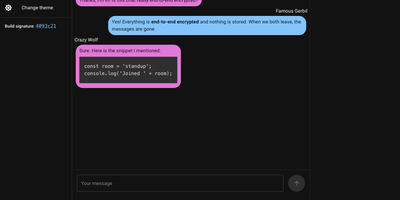
Chitchatter is a browser-based chat room for text, voice, video, screen sharing, and file transfers that exists only while its members are connected and keeps no record of what was said. Every visit starts with a random room name generated on your device, a UUID or a readable passphrase, and you invite people with the link or a QR code. Public rooms admit anyone with the link; private rooms also require a matching password. Messages support Markdown, multiline text, and code blocks, and clicking a name opens a direct conversation. Newcomers to public rooms receive the earlier conversation from peers already there, and typing indicators show who is writing. Start an audio or video call, share your screen to walk a relative through a settings problem, or hand over a file of any size, encrypted before it leaves your browser. Public-key checks verify each peer automatically, with a green lock marking everyone who passes and an icon showing whether the link is direct or relayed. Embed a room in any web page with an iframe or a web component that takes a room name, user name, and color mode. Light and dark themes are built in, and notifications and sounds announce new messages while you work in another tab. Close the tab and the transcript disappears. Running on a dedicated VPS on RepoCloud with guaranteed CPU, RAM, and SSD, full root SSH access, and a browser serial console. GPL-2.0 licensed.
Fireshare
FireShare turns a folder of game captures on your server into a browsable library where every clip gets its own permanent link, ready to paste into Discord the moment something worth bragging about happens. Point it at the directories you already record to and it scans what is there: the file people watch is always your untouched original, in MP4, WebM, or MOV, never a recompressed stand-in. Privacy is set per file, public for the feed, link-only for friends, or behind a password, and whole folders can be shared as a single link. It also sorts the chaos for you, detecting the game in each capture and shelving hundreds of timestamped filenames under proper cover art you can search and browse. Trim the dead air off a clip before posting it, add a title, description, tags, and a custom thumbnail, and watch the view count climb. For screens that struggle with huge originals, optional transcoding adds adaptive lower qualities on CPU or an NVIDIA GPU, and HDR captures get tone-mapped to SDR instead of looking washed out. Friends can upload through the browser or by token from scripts, new public clips can announce themselves to Discord or an RSS reader, and accounts come with permissions, profiles, and two-factor sign-in. Running on a dedicated VPS on RepoCloud with guaranteed CPU, RAM, and SSD, full root SSH access, and a browser serial console. GPL-3.0 licensed.
MicroBin
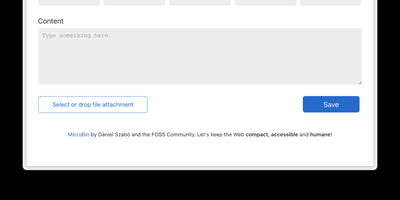
A video too large for Discord, a secret that should not live in a chat log, or a config file a headless server needs to fetch: MicroBin turns each into a short link with an animal name, served from your own machine. Paste text or code and it comes back with syntax highlighting, inline image and video embedding, and a QR code for moving it to a phone. Attach one file or several, then decide exactly who can see them: uploads can be public or private, editable or locked, set to expire on a schedule or to never expire. For sensitive material, server-side encryption and client-side end-to-end encryption keep contents unreadable without the password. Raw serving hands the plain bytes to curl, a browser, or another program, which makes the same box a tiny file endpoint for scripts and test rigs. A postbox mode lets people send you files and texts they cannot browse or delete afterwards, and a read-only mode with an uploader password turns the instance into a drop point with exactly one trusted sender. The admin console lists uploads and storage, and everything runs as one small binary backed by SQLite or a JSON file, comfortable in a few megabytes of memory. Running on a dedicated VPS on RepoCloud with guaranteed CPU, RAM, and SSD, full root SSH access, and a browser serial console. BSD-3-Clause licensed.
Papra
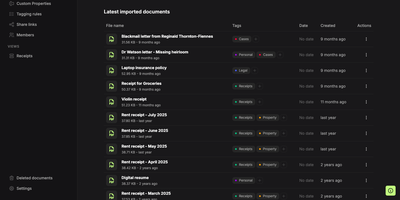
Somewhere between the shoebox and the inbox, Papra keeps receipts, warranties, and leases in a self-hosted archive you can actually search. Upload a photographed receipt and built-in OCR reads its text, so a search for the store name finds it later. Searches combine name:, content:, tag:, created:, and has: filters with AND, OR, NOT, and parentheses, and any query can be saved as a sidebar view. Tagging rules label uploads by name or content and can be applied to documents already stored. Optional AI auto-tagging works with a cloud provider or a local model such as Ollama. Custom properties add searchable typed fields such as text, number, date, yes or no, and select. Organizations keep a household's or a team's archive apart, with owner, admin, and member roles. Share links let outsiders open a document without an account, with optional passwords and expiry dates, and each link can be switched off. Forward an email to a generated address, or drop files into a watched folder, and documents arrive without opening the app; both are opt-in. Deleted files wait 30 days in the trash, and optional encryption protects stored files. Sign in with email, GitHub, Google, or a custom OAuth2 provider, and script the archive through the API, SDK, CLI, or webhooks. Running on a dedicated VPS on RepoCloud with guaranteed CPU, RAM, and SSD, full root SSH access, and a browser serial console. AGPL-3.0 licensed.