Open Source App Cloud Marketplace
Deploy, host, and scale with one click, at half the cost. Then customize with AI agents.
Utopia
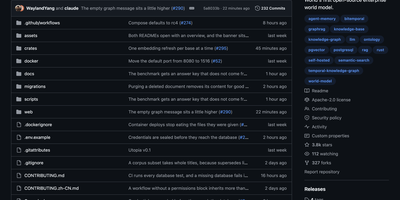
The first open-source substrate for enterprise knowledge engineering that learns passively and governs itself. The Rust-built backend paired with PostgreSQL and pgvector delivers a bitemporal knowledge graph where every fact carries two timelines: when it held in the real world and when the system came to believe it — enabling full audit trail replay of how understanding evolved. Document ingestion handles PDF, DOCX, PPTX, XLSX, CSV, Markdown, HTML, and plain text with legacy encoding detection, while scheduled syncing pulls from web pages, RSS feeds, GitHub, Jira, Notion, WebDAV, and S3-compatible buckets. Search fuses Tantivy full-text indexing with pgvector semantic vectors using Reciprocal Rank Fusion, streaming answers with inline citations that link directly to source passages. The built-in agent harness drives agentic RAG through conversation — searching documents, walking the knowledge graph at any historical date, and querying mounted databases via Ontology2SQL which achieves state-of-the-art results on BIRD Mini-Dev benchmarks. Five ontology packs ship inside the binary (schema.org, W3C Org, PROV-O, FOAF, IOF Core) with forward-chaining reasoning for transitivity, symmetry, inverses, and relation hierarchy. Entity resolution operates in three stages: exact name matching, embedding similarity, then model-based judgment with every merge reversible. Any OpenAI-compatible endpoint works including DeepSeek, Qwen, Ollama, and vLLM for fully air-gapped deployment. Running on a dedicated VPS on RepoCloud with guaranteed CPU, RAM, and SSD, full root SSH access, and a browser serial console. Apache-2.0 licensed.
Immich
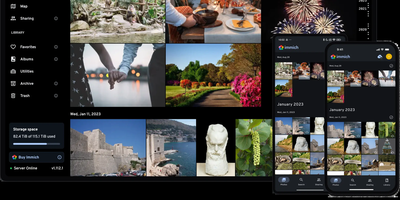
With over 110,000 GitHub stars and one of the fastest-growing open-source communities in the self-hosted space, Immich delivers a Google Photos-grade experience entirely on your own hardware. The platform handles automatic background backup from Android and iOS devices, deduplication, and support for RAW formats, LivePhotos, and MotionPhotos. Its machine learning pipeline runs facial recognition and clustering locally on your server, enabling you to group photos by person without sending a single image to the cloud. CLIP-based semantic search lets you find images by describing their content in natural language, while metadata-driven search covers EXIF data, dates, and locations. The web interface built with SvelteKit provides a responsive timeline view, albums, shared albums with configurable permissions, public sharing links with optional passwords and expiry dates, partner sharing for family libraries, and a global map plotting photos by GPS coordinates. Administrative features include multi-user support with per-user storage quotas, OAuth integration, API key management, and a user-defined storage structure for organizing files on disk. The architecture uses PostgreSQL for metadata, Redis with BullMQ for background job queues handling thumbnail generation, video transcoding, and smart search indexing, and exposes over 400 REST API endpoints documented via OpenAPI with auto-generated SDKs for web, mobile, and CLI clients. Running on a dedicated VPS on RepoCloud with guaranteed CPU, RAM, and SSD, full root SSH access, and a browser serial console. AGPL-3.0 licensed.
etcd
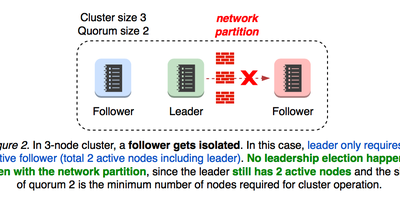
With over 52,000 GitHub stars and its role as the foundation of every Kubernetes cluster worldwide, etcd is the distributed key-value store that handles the most critical data in modern infrastructure — cluster state, configuration, service discovery, and distributed coordination. Built in Go and graduated from the CNCF, etcd uses the Raft consensus algorithm to maintain a strongly-consistent, highly-available replicated log across a cluster of machines, gracefully handling leader elections during network partitions and tolerating machine failure including the leader node. The gRPC API provides atomic key-value operations including put, get, delete, and transactions with multi-key compare-and-swap semantics, enabling distributed locking, leader election, and configuration management without external coordination. Watch operations stream real-time change notifications for specific keys or key ranges, powering reactive architectures that respond immediately to configuration updates. Version 3.7 introduces RangeStream for streaming large result sets in chunks, keys-only range requests for faster metadata queries, and bootstraps entirely from v3store after eliminating the legacy v2 store dependency. Automatic TLS encryption with optional client certificate authentication secures all cluster communication, while role-based access control restricts key access per user. The embedded bbolt B+ tree storage engine provides consistent reads and writes with configurable compaction policies. Benchmarked at 10,000 writes per second per instance with linearizable reads, etcd supports clusters of 3, 5, or 7 members for fault tolerance. Running on a dedicated VPS on RepoCloud with guaranteed CPU, RAM, and SSD, full root SSH access, and a browser serial console. Apache 2.0 licensed.
GPT Load
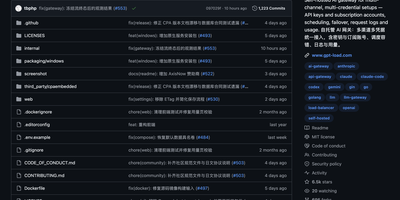
GPT Load has become the go-to self-hosted AI gateway for teams managing multiple LLM provider credentials behind a single URL. The Go-built proxy transparently preserves native API formats for OpenAI Chat Completions, OpenAI Responses, Anthropic Messages, and Google Gemini — applications swap one base URL and keep their existing SDK integration untouched. Twenty built-in channels cover official APIs (OpenAI, Anthropic, Gemini, xAI), cloud platforms (Azure OpenAI, AWS Bedrock, Google Vertex AI), model services (DeepSeek, Moonshot AI, SiliconFlow, Zhipu AI, Alibaba Cloud, Volcengine, OpenRouter, Groq), and subscription accounts (Codex, Claude, Antigravity, Grok) using the same credential management, scheduling, and health system. The intelligent key pool rotates among valid credentials using atomic counters for fair high-concurrency distribution, automatically blacklists failing keys after configurable thresholds, and recovers them via scheduled health checks — all transparent to clients. Weighted load balancing distributes traffic across multiple upstream endpoints while per-credential proxies route individual keys through different egress paths. The Vue 3 management dashboard provides real-time statistics, group configuration, key testing, request logs with full debugging context, per-model cost estimates, and route inspection. Docker deployment exposes the management interface and proxy on port 3001 with SQLite by default, MySQL or PostgreSQL optional, and Redis for distributed leader-follower cluster scaling. Running on a dedicated VPS on RepoCloud with guaranteed CPU, RAM, and SSD, full root SSH access, and a browser serial console. MIT licensed.
Flowise
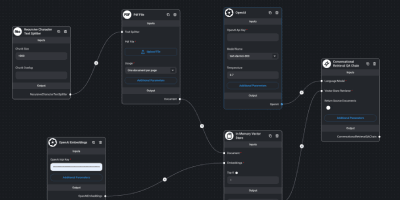
Drag nodes onto a canvas and ship an LLM app: Flowise is an open-source visual builder for AI agents and LLM applications, written in Node.js on LangChain.js and licensed Apache-2.0. You assemble flows by dragging nodes onto a canvas: models, prompts, memory, vector stores, retrievers, and tools, then wire them together and test in the built-in chat panel. Three builder types cover increasing complexity: Assistant for simple RAG chat over uploaded files, Chatflow for single-agent systems with techniques like rerankers and Graph RAG, and Agentflow for multi-agent orchestration with branching, looping, shared flow state, and human-in-the-loop checkpoints. Over 100 integrations connect data sources, vector databases, and both proprietary and open-source models, plus MCP client and server nodes for standard tool interop. Finished flows are exposed as REST APIs, embedded chat widgets, or via JS and Python SDKs - each flow gets an endpoint the moment it is saved, removing the deployment gap between a working prototype and something your application can call. Execution logs, visual step debugging, and external log streaming trace behavior, while input moderation and rate limiting act as guardrails; RBAC, SSO, and workspaces cover team deployments. Self-hosting keeps prompts, encrypted credentials, and conversation data on your own instance, which matters when flows handle internal documents or customer data - and wiring a model, prompt, memory, and vector store on the canvas replaces the boilerplate a hand-coded LangChain project would need.

Open-Meteo
High-resolution weather forecasts became a free commodity because of Open-Meteo - and this deployment puts the whole open-source engine on your own infrastructure. The public open-meteo.com service aggregates national weather models (NOAA GFS, DWD ICON, ECMWF, Meteo-France, and others) into one consistent JSON interface; self-hosting gives you that same API without rate limits, third-party dependency, or usage metering. The architecture is two cooperating services: the API server exposes forecast endpoints fully compatible with Open-Meteo query parameters - latitude, longitude, hourly and daily variables like temperature, precipitation, wind, and radiation - while a background sync worker downloads fresh weather model data on a configurable interval into a shared persistent volume at /app/data, so forecasts stay current and survive restarts without re-downloading. You control which weather models to mirror, which variables to store, how much historical depth to keep, and how often to refresh - meaning a lean deployment can sync only the model and region you actually query. Responses are plain HTTP/JSON, so integration with dashboards, Home Assistant-style automations, agricultural monitoring, IoT fleets, or any application takes minutes. For anyone making thousands of forecast calls a day, replacing a metered weather API with your own instance turns a recurring bill into a flat infrastructure cost.
BigBlueButton
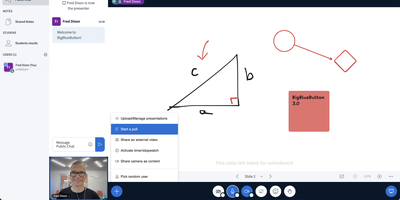
Used daily by millions of educators and learners in over 65 languages and embedded as the default virtual classroom in Moodle Cloud, Canvas, Sakai, D2L, Jenzabar, and Schoology — together comprising more than 75% of the worldwide learning management system market — BigBlueButton has been the leading open-source web conferencing platform for education since its creation at Carleton University in 2007. The platform delivers WebRTC-based real-time audio, video, and screen sharing with a tldraw v2-powered multi-user whiteboard featuring infinite canvas support, allowing multiple participants to annotate slides and draw simultaneously. Breakout rooms support up to eight concurrent groups with collaborative whiteboards enabled by default, and polling with customizable response types lets instructors assess understanding in real time. The built-in Learning Analytics Dashboard answers three questions at a glance: who is attending, who is participating, and who is learning based on poll responses, providing actionable engagement metrics without requiring webcam surveillance. Session recording captures audio, video, slides, chat, and whiteboard annotations for asynchronous playback on any device. The plugin architecture introduced in version 3.0 enables custom extensions, while IMS LTI 1.0 compliance allows integration with Blackboard, Desire2Learn, Pearson Learning Studio, and any conformant platform without custom code. The REST API enables programmatic session management, user authentication, and recording access for custom frontends like the included Greenlight application. Version 4.0 introduces LiveKit-based media and a redesigned interface. Running on a dedicated VPS on RepoCloud with guaranteed CPU, RAM, and SSD, full root SSH access, and a browser serial console. LGPL-3.0 licensed.
SiYuan
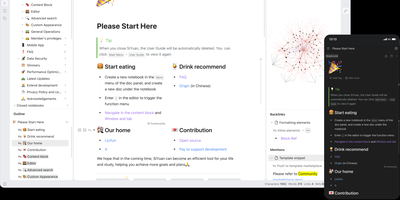
Backed by over 45,000 GitHub stars and described as the tool that replaces Notion, Evernote, and Anki in a single Docker container, SiYuan is the privacy-first knowledge management system where every paragraph, heading, and list item is a uniquely addressable content block. The block-level architecture enables bidirectional links, transclusion embeds, and SQL query blocks that dynamically aggregate content across your entire workspace, while the knowledge graph visualization maps relationship networks between documents and blocks. Built-in databases support table views with relation and rollup columns, filter composition, sorting, and template-based calculations for structured data management alongside freeform notes. The FSRS spaced repetition engine turns any content block into a flashcard with scientifically calibrated review scheduling, eliminating the need for separate memorization tools. AI integration connects to OpenAI-compatible APIs for writing assistance, translation, summarization, and Q&A chat, with semantic search using embeddings and reranking for intelligent content retrieval. The Bazaar community marketplace delivers plugins, themes, templates, and widgets through a managed extension system with TypeScript plugin APIs. End-to-end encrypted synchronization works across S3-compatible storage, WebDAV servers, or SiYuan's own cloud service, while Tesseract OCR extracts searchable text from images and the web clipper captures pages from Chrome, Edge, and Firefox. Export targets include Markdown with assets, PDF, Word, and HTML. Running on a dedicated VPS on RepoCloud with guaranteed CPU, RAM, and SSD, full root SSH access, and a browser serial console. AGPL-3.0 licensed.

Frappe LMS
Frappe LMS is a learning management system built on the same Frappe Framework that powers ERPNext. The 3-level course hierarchy organizes content into courses, chapters, and lessons supporting videos, PDFs, SCORM packages, and rich HTML content with heading, code block, and list formatting through the redesigned inline lesson editor. Batch management groups learners by course and duration with scheduled instructor-led live sessions through integrated Zoom and Google Meet, where learners see upcoming classes on their batch dashboard. The assessment engine supports single-choice, multiple-choice, and open-ended quiz questions alongside assignment submissions as PDFs or documents, with progress tracking monitoring completion rates and quiz performance across all enrolled courses. Certificate generation uses built-in templates or custom designs to validate course completion, while the job board connects certified learners with opportunities. Course monetization integrates payment processing to transform courses into revenue streams with financial tracking. Role-based access controls assign Instructor, Learner, Admin, and Manager permissions, while course package import and export enables sharing structured content between instances. The platform integrates with ERPNext HR and CRM modules through the Frappe ecosystem with RTL language support and notification slide-overs. Running on a dedicated VPS on RepoCloud with guaranteed CPU, RAM, and SSD, full root SSH access, and a browser serial console. AGPLv3 licensed.
Solidtime
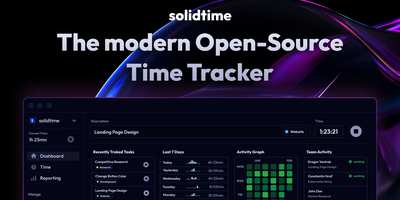
Solidtime is a time tracker for freelancers and agencies, offering a modern SaaS-quality interface that rivals commercial tools like Toggl and Clockify. The time tracking interface provides a running timer, calendar view, and weekly timesheet for flexible entry across desktop, mobile, and the dedicated macOS, Windows, and Linux desktop applications. Project management organizes work by client with hierarchical billable rates configurable at organization, member, project, and project-member levels, ensuring accurate billing across complex team structures. The invoicing module generates polished PDF invoices and structured EU e-invoices with configurable VAT rates, percentage and fixed discounts, EU reverse-charge handling, reusable company templates, and automatic line item generation from billable time entries. Reporting provides filterable summaries by user, project, client, and date range with exportable data for billing audits and team retrospectives. Multi-organization support manages separate workspaces from a single account with role-based permissions controlling access across organizations. Data import from Toggl, Clockify, and generic Timeentry CSV files enables migration from existing tools without losing historical records. The RESTful API with bearer token authentication enables automation and integration with external services. Docker deployment with PostgreSQL runs behind Nginx or Traefik reverse proxy. Running on a dedicated VPS on RepoCloud with guaranteed CPU, RAM, and SSD, full root SSH access, and a browser serial console. AGPL-3.0 licensed.
OpenPencil
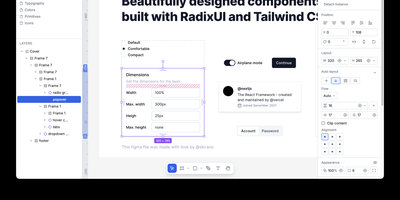
OpenPencil is the open-source design editor that reads and writes native Figma .fig files using the same Kiwi binary format — enabling bidirectional copy-paste between Figma and OpenPencil without data loss. The built-in AI assistant provides 90+ design tools through a chat interface, creating and modifying shapes, fills, strokes, auto-layout, components, variables, and boolean operations from natural language prompts, with BYOK support for Anthropic, OpenAI, Google AI, OpenRouter, Z.ai, MiniMax, and compatible endpoints. A Skia CanvasKit WASM renderer paired with Yoga WASM layout engine delivers Figma-parity rendering with flex and CSS Grid support including gap, padding, and alignment. The headless CLI inspects node trees via XPath queries, lints naming and accessibility, converts between document formats, analyzes color and typography patterns, extracts design tokens, and exports to PNG, SVG, JSX/Tailwind, and HTML. An MCP server exposes all design operations over stdio and HTTP, connecting Claude Code, Cursor, Windsurf, and Gemini CLI for AI-assisted design automation. Real-time P2P collaboration via WebRTC with Yjs CRDT synchronization requires no server and no account. The Vue SDK provides headless components for embedding the editor into custom applications. Ships as a 7 MB Tauri v2 desktop app for macOS, Windows, and Linux, or runs in any browser as a PWA. Running on a dedicated VPS on RepoCloud with guaranteed CPU, RAM, and SSD, full root SSH access, and a browser serial console. MIT licensed.
Cloudflare OS
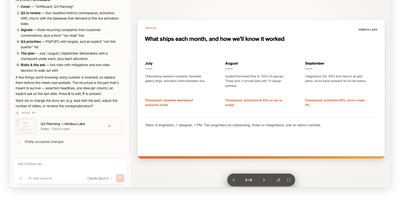
With over 7,700 GitHub stars and thousands of Cloudflare employees using it daily across every function, Cloudflare OS delivers an open-source AI workspace where every employee gets a personal agent grounded in company context, systems, and skills — not a generic chatbot but a programmable workspace that builds real applications, automates workflows, and connects to internal tools through governed access. The Code Mode agent writes and immediately executes code snippets to perform arbitrary tasks, build full-stack Gadgets with client code, server code, APIs, and durable SQLite state, debug errors, and test results within isolated sandboxes. Gadgets are private application instances running in separate sandboxes — each document, spreadsheet, or tool is its own secure runtime that cannot leak data even to attackers with access to other Gadgets. Blueprints enable sharing application code as templates that others instantiate with independent state, credentials, and resources. Gatekeepers provide security governance giving system owners precise control over what agents can see, change, and when human approval is required before actions execute. Built on Cloudflare Workers using Durable Objects for workspace persistence, Dynamic Workers for Gadget execution, and Facets for access management. Zero Trust security via Cloudflare Access verifies every user and request before granting access. Real-time collaboration lets colleagues use shared Gadgets. Deploy to your own Cloudflare account or self-host on workerd, the open-source Workers runtime, on your own servers. Running on a dedicated VPS on RepoCloud with guaranteed CPU, RAM, and SSD, full root SSH access, and a browser serial console. Apache-2.0 licensed.
Coder
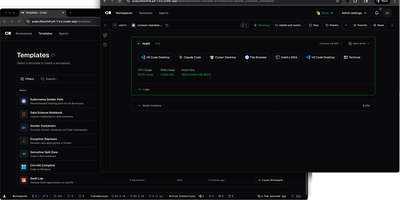
With over 14,000 GitHub stars and enterprise adoption by security-conscious organizations, Coder transforms how development teams provision, manage, and secure their coding environments. Every workspace is defined as a Terraform template, meaning infrastructure engineers can standardize development environments across EC2 instances, Kubernetes pods, Docker containers, or any combination, while developers get self-service provisioning that launches in seconds rather than days of manual setup. The WireGuard-based networking layer establishes encrypted tunnels between developer machines and remote workspaces, providing low-latency access without exposing ports or configuring VPN concentrators. Automatic idle detection shuts down unused workspaces after configurable periods, directly reducing cloud compute costs for organizations running hundreds of developer environments. The Coder Agents feature introduces native AI coding capabilities where the agent loop executes entirely within the control plane on self-hosted infrastructure, keeping LLM API credentials out of individual workspaces and eliminating credential exfiltration risks. Centralized model governance allows platform teams to approve specific AI providers and models, set per-user spend limits, and maintain complete audit logs of all prompts, tool calls, and agent activity. IDE integration supports VS Code through a dedicated extension, JetBrains IDEs via Gateway and Toolbox plugins, and browser-based code-server for web access. The template registry provides pre-built configurations for common development stacks. DevContainer support builds environments from standard devcontainer.json specifications. Deploy on a dedicated VPS on RepoCloud with guaranteed CPU, RAM, and SSD, full root SSH access, and a browser serial console. AGPL-3.0 licensed.
Bifrost
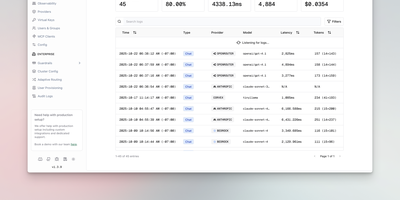
Bifrost is an open-source AI gateway that unifies 23+ LLM providers into a single OpenAI-compatible endpoint with automatic failover, semantic caching, and built-in cost governance, so one provider going down never takes your production AI application with it. Point your existing OpenAI or Anthropic SDK at Bifrost's local endpoint and gain access to OpenAI, Anthropic, AWS Bedrock, Google Vertex, Azure, Groq, Mistral, and Ollama without changing application code. Define fallback chains that automatically switch providers when one returns errors or exceeds latency thresholds, keeping response times stable during outages. The built-in web dashboard at port 8080 lets you configure providers, create virtual API keys, monitor live request traffic, and review analytics without editing configuration files. Semantic caching combines exact hash matching with vector similarity search via Weaviate, serving cached responses for identical or paraphrased prompts in sub-millisecond time to cut costs on repetitive workloads. The MCP gateway connects AI agents to external tools like filesystems, databases, and web APIs, exposing them to clients such as Claude Desktop and Cursor with per-key allow-lists. Four-tier budget hierarchy at customer, team, virtual key, and provider levels enforces spend caps, rate limits, and model restrictions across your organization. Extend functionality through custom Go plugins for analytics, monitoring, or security middleware. Native Prometheus metrics and OpenTelemetry distributed tracing give operations teams full production observability. Running on a dedicated VPS on RepoCloud with guaranteed CPU, RAM, and SSD, full root SSH access, and a browser serial console. Apache 2.0 licensed.

Gods Eye View
God's Eye View turns your browser into a real-time spatial intelligence command center, rendering thousands of live aircraft, ships, satellites, earthquakes, traffic flows, and public cameras on a photorealistic 3D Earth powered by CesiumJS and Google Photorealistic 3D Tiles. Click any aircraft to see its transponder telemetry from OpenSky and adsb.lol, including route history, altitude, speed, and callsign; track live vessel positions worldwide through AIS beacon data from AISStream; or follow roughly 840 satellites color-coded by class using orbital elements from CelesTrak. A hands-free voice agent powered by the OpenAI Realtime API lets you ask the planet questions in natural language, and the globe annotates your answer directly in 3D space. Toggle FLIR mode for a thermal camera aesthetic, layer in NASA FIRMS wildfire data, switch between Google 3D, Bing aerial, and OpenStreetMap base layers, or tune into a geolocated world radio dial. Public CCTV cameras are projected into 3D city geometry with viewshed cones and direct-manipulation calibration. The cockpit mode provides a pilot-style briefing surface with mission-specific overlays. Entity inspection panels show detailed metadata for every tracked object, and shareable links let you send any scene configuration to a colleague. Ten of the thirteen live data layers work with zero API keys, while the required Google Maps key offers 1,000 free 3D tile sessions per month. Running on a dedicated VPS on RepoCloud with guaranteed CPU, RAM, and SSD, full root SSH access, and a browser serial console. MIT licensed.
GPT Researcher
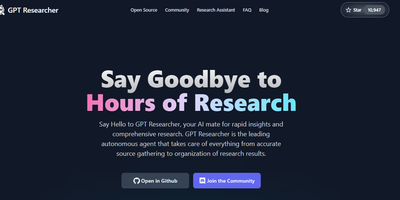
A question goes in; a cited, long-form report comes out - GPT Researcher is an open-source autonomous research agent. A planner agent decomposes the query into sub-questions, execution agents crawl 20+ web sources in parallel with JavaScript-enabled scraping, and a publisher aggregates findings into a 2,000+ word report with inline citations, exportable to PDF, Word, and Markdown. The Deep Research mode extends this recursively: each result yields follow-up questions that are explored to configurable breadth and depth in a tree pattern, while accumulated learnings, citations, and visited URLs are shared across branches. It also researches local documents (PDF, CSV, Word) alongside the web. LLM and search providers are pluggable, including OpenAI, Anthropic, Google, DeepSeek, and Ollama for models, and Tavily, Google, Bing, DuckDuckGo, and SearXNG for retrieval. It ships as a Python package, a FastAPI server with web frontend, a Docker image, and an MCP server for use inside Claude or Cursor. MIT-licensed.
Pixelle Video
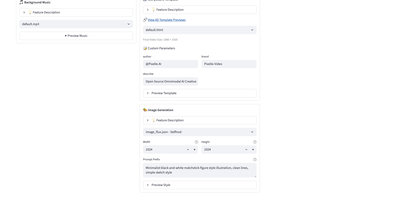
Backed by Alibaba's AIDC team and carrying over 27,700 GitHub stars, Pixelle-Video turns a single text prompt into a publish-ready short video in approximately three minutes — handling scriptwriting, image generation, voice narration, music selection, subtitle overlay, and final MP4 export in one automated pipeline. The engine supports multiple LLM backends for script generation including GPT-4, Qwen, DeepSeek, and local Ollama deployments, while image and video creation routes through either self-hosted ComfyUI workflows, cloud-based RunningHub pipelines, or direct API connections to DashScope Wan, OpenAI, Seedream, Seedance, and Kling AI. Text-to-speech synthesis uses Edge-TTS, Index-TTS, and other mainstream engines with multi-language voice profiles. Five distinct pipelines cover Quick Create, Standard, Digital Human Avatar broadcasting, Image-to-Video transformation, and Motion Transfer from reference video. The Streamlit web UI on port 8501 provides a visual workflow builder with template selection across portrait (1080x1920), landscape (1920x1080), and square formats, while the FastAPI server on port 8000 exposes a REST API with endpoints for async video generation, task polling, content scripting, TTS and image generation, template listing, and health checks. History persistence tracks all completed generations. HTML-based visual templates support static, image-overlay, and AI-video styles with customizable prompt prefixes. The modular architecture lets operators swap any atomic capability — image model, video model, TTS engine, or VLM — by editing a workflow JSON file without touching Python code. Running on a dedicated VPS on RepoCloud with guaranteed CPU, RAM, and SSD, full root SSH access, and a browser serial console. Apache 2.0 licensed.
Auto Company
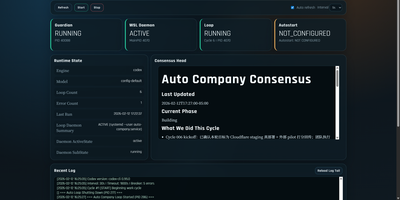
With over 2,700 GitHub stars, Auto Company is the first open-source framework that runs a fully autonomous AI company 24/7 — 14 specialized agents modeled after Jeff Bezos (CEO strategy), Werner Vogels (CTO architecture), Charlie Munger (critical analysis), DHH (full-stack engineering), Kelsey Hightower (DevOps), Seth Godin (marketing), and eight more domain experts collaborate through dynamic squad formation to ideate products, write code, deploy infrastructure, and execute marketing campaigns without human intervention. The five-layer architecture separates execution, orchestration, cognition, workflow routing, and observability, while the consensus memory pattern uses a single markdown file as a relay baton between cycles — no vector databases, no Redis, no embeddings required. A bash loop invokes Claude Code or OpenAI Codex CLI every 30 seconds, each cycle selecting 2-5 agents from the 14-person pool based on task context. Over 30 reusable skills handle specialized tasks from frontend design to competitive analysis and deployment automation. Circuit breakers trigger cooldown after consecutive errors, rate-limit detection auto-sleeps on API throttling, and sandbox rollback protects against destructive changes. The Python-powered web dashboard displays real-time cycle status, cost tracking per cycle averaging under $2, and agent activity visualization, with CLI control via make start, stop, monitor, pause, and resume. Supports macOS via launchd, Windows via WSL with systemd, and native Linux deployment. The npx create-auto-co command scaffolds a new AI company in seconds. Running on a dedicated VPS on RepoCloud with guaranteed CPU, RAM, and SSD, full root SSH access, and a browser serial console. MIT licensed.